.webp)

.jpeg)
 ChatGPT
 Perplexity
 Gemini
 Grok
Grok
 Claude
A proposal cover letter is a one-page introduction that sits in front of your business or RFP proposal, framing who you are, why you understand the client's problem, and why you're the right team to solve it. This is the seller's cover letter, the one you send with a B2B bid or RFP response, not a job application. Below you'll find a copy-paste template, an annotated example, and a clear breakdown of how a cover letter differs from your executive summary and the proposal itself.
Most cover letters fail for the same reason: they restate the proposal in duller words. A good one does something the rest of your document can't, it makes a human connection in the first 30 seconds, before the prospect ever scrolls to your pricing. This guide shows you how to write one that earns the read, whether you're an agency pitching a retainer, a freelancer quoting a project, or a team responding to a formal RFP.
What is a proposal cover letter?
A proposal cover letter is a short, personalized note, usually one page, that introduces your proposal to a prospective client and explains, in plain language, why your offer is worth their attention. It's the first thing the decision-maker reads, and it sets the tone for everything that follows.
In a B2B or RFP context, the cover letter does a specific job. Your proposal proves what you'll deliver and how much it costs. The cover letter answers the quieter questions the buyer asks before they even start reading: Do these people get my situation? Are they easy to work with? Should I keep going? It's relationship before logic, the handshake before the pitch.
This matters most for sellers competing on trust rather than price: agencies, design studios, consultants, and freelancers. When two firms submit similar scopes at similar prices, the cover letter is often where the human edge shows up. It's the one part of the document where you're allowed to sound like a person rather than a vendor.
One quick clarification, because the search term is ambiguous: this article is about the seller-side proposal cover letter, the one that accompanies a commercial offer or a response to a request for proposal. It is not a job-application cover letter, and it's not a grant or academic cover letter, though many of the same principles apply.
Cover letter vs executive summary vs the proposal
This is the single most common source of confusion, so let's settle it. A cover letter, an executive summary, and the proposal itself are three different documents with three different jobs. They overlap in content but not in purpose.
The cover letter creates the connection. The executive summary distills the offer. The proposal delivers the detail. Here's how they compare side by side.
The practical takeaway: don't make your cover letter a mini-executive-summary. If it just repeats your pricing and deliverables in shorter form, you've wasted your one chance to be human. Use the cover letter to show you understand the client; use the executive summary to show them what they're getting.
What's the difference between a cover letter and a proposal?
A cover letter is a one-page introduction that builds a personal connection and frames why you're the right fit. The proposal is the full document that specifies the scope, approach, deliverables, timeline, and pricing. The cover letter sells you; the proposal sells the work.
Does your proposal need a cover letter?
In most B2B and RFP situations, yes. For formal RFPs, a cover letter is frequently a required submission item, the buyer expects it, and leaving it out can read as careless. Even when it isn't required, including one is almost always a net positive: it's the cheapest way to differentiate a proposal that otherwise looks like every competitor's.
There are a few cases where you can skip it. If you're sending a quick, low-stakes quote to an existing client who already knows you, a cover letter can feel like overkill, a short email intro does the same work. And if the RFP explicitly limits what you can submit, follow the instructions to the letter; in formal procurement, SBA guidance on winning government contracts is a reminder that compliance with submission rules is non-negotiable.
The rule of thumb: the higher the deal value and the colder the relationship, the more a cover letter earns its place. A new $15K agency retainer deserves one. A $400 add-on for a client you've worked with for two years probably doesn't.
How to write a proposal cover letter, step by step
Here's the structure that works across business proposals, RFP responses, and freelance pitches. Six steps, top to bottom. Keep the whole thing to one page.
1. Header and contact info
Open with the basics, formatted cleanly: your name and company, the date, and the recipient's name and organization. Address a real person whenever possible, "Dear Ms. Okafor" beats "To whom it may concern" every time. If the RFP names a procurement contact, use it. Getting the name right is a small signal that you read the brief, and small signals compound.
2. A strong opening line
Your first sentence decides whether the rest gets read. Skip the throat-clearing ("We are pleased to submit our proposal in response to…") and lead with something that proves you've been paying attention, a reference to their goal, their challenge, or a specific detail from their brief. The opening line should feel written for them, not pasted from your last ten proposals.
3. Show you understand their problem
Before you talk about yourself, prove you understand the client's situation. Restate their problem in your own words, the way a good consultant plays back a brief to confirm they heard it. This is the single highest-leverage move in the whole letter. When a prospect reads their own challenge described accurately, the unspoken reaction is "finally, someone gets it," and you've earned the benefit of the doubt for everything that follows.
4. Frame your solution and approach
Now, and only now, introduce what you propose to do, at a high level, not in detail. Two or three sentences on your approach and why it fits their situation specifically. Don't dump the scope here; that's what the proposal is for. The cover letter just needs to make the client want to turn the page. Connect your approach back to the outcome they care about.
5. Prove it (results and credibility)
Add one piece of evidence that you can actually back: a comparable project, a relevant result, a named client in their industry, or a credential the RFP asked for. Specificity wins, "we rebuilt the booking flow for a SaaS client and cut their drop-off meaningfully" lands harder than "we have a proven track record." Keep it to one or two lines. The proof points live in the proposal body; the cover letter just needs one to establish credibility.
6. Clear next step and CTA
Close by telling the reader exactly what happens next: a call to walk through the proposal, a link to the live document, your availability, your direct contact. A vague "we look forward to hearing from you" leaves the ball nowhere. A clear "I'll follow up Thursday, or grab a time here" moves the deal. End with a confident, warm sign-off, you're inviting a conversation, not begging for one.
How long should a proposal cover letter be?
One page. As a rule, aim for 300 to 400 words, long enough to make a connection, short enough to respect a busy decision-maker's time. The only exception is a formal RFP that specifies a different length or format; in that case, follow the RFP's instructions exactly.
Want a faster way to turn that cover letter into a finished proposal?
Skip the blank page. Start from a branded, ready-to-edit proposal template and have your intro, scope, and pricing in one place.
→ Browse proposal templates
Proposal cover letter template (copy-paste)
Here's a paste-ready proposal cover letter template you can adapt in five minutes. Replace the bracketed parts, cut anything that doesn't apply, and keep it to one page. It maps directly to the six steps above and works for a business proposal template or an RFP response.
[Your Name]
[Your Company] · [Email] · [Phone]
[Date]

[Recipient Name]
[Recipient Title], [Client Company]

Dear [Recipient Name],

[Opening line: reference their specific goal or challenge.
e.g., "You're launching in three new markets this fall, and your
current proposal process can't keep up. That's exactly the kind of
problem we solve."]

[Problem restatement: show you understand their situation in your
own words. Two or three sentences. e.g., "From your brief, the real
issue isn't the website itself, it's that the booking flow loses
people before they convert, and every fix so far has been a patch."]

[Solution framing: high-level approach, tied to their outcome.
e.g., "We'd rebuild the flow around a single, friction-free path to
booking, designed to recover the drop-off you're seeing and give you
clean data on where prospects hesitate."]

[Proof point: one credible, specific result or reference.
e.g., "We did this recently for [comparable client], and their
qualified bookings rose meaningfully within the first quarter."]

[Next step: a clear, concrete CTA.
e.g., "The full proposal is attached / linked below. I'll follow up
Thursday, or you can grab 20 minutes with me here: [link]."]

Looking forward to building this with you,

[Your Name]
[Your Title], [Your Company]
That's the whole thing, no filler, no "we are pleased to submit." If you find yourself writing a paragraph that could appear in anyone's proposal, delete it.
Annotated proposal cover letter example
Templates are useful; seeing one filled in is better. Here's a complete proposal cover letter example for a design agency responding to a website redesign brief, with notes on why each part works. This is calibrated for the agency-and-freelance reader, adapt the voice to your own.
Dear Mariе,
(Real name, correctly spelled, already ahead of the "Dear Sir/Madam" crowd.)
You told us the new Lumen site has to do one thing above all: turn your demo traffic into booked calls. Right now it's leaking both.
(Opening line. No throat-clearing. It quotes the client's own goal and names the real problem in a single beat. The reader thinks: they were listening.)
From our discovery call, the issue isn't the design, it's the path. Visitors land on a strong homepage, get curious, and then lose the thread before they ever reach "book a demo." You've changed the hero three times; the drop-off hasn't moved. That tells us the fix lives in the flow, not the front page.
(Problem restatement. It plays the brief back accurately and even reframes it, proof of understanding, not just attention.)
We'd rebuild Lumen's site around one job: getting the right visitor to a booked call with as little friction as possible. Clear path, fewer decisions, instrumentation at every step so you can finally see where people hesitate. Design that serves the conversion, not the other way around.
(Solution framing. High-level, outcome-led, no scope dump. It makes you want to read the actual proposal.)
We rebuilt exactly this kind of flow for a B2B SaaS client last year, and their qualified demo bookings climbed meaningfully within a quarter. The full approach, timeline, and pricing are in the proposal that follows.
(Proof point + handoff. One specific, defensible result. Then it points cleanly to the document doing the heavy lifting.)
Open the proposal here, it'll show you when each section landed for your team, and you can sign and kick off right inside it. I'll follow up Friday, or grab 20 minutes with me anytime: [link].
(CTA. Concrete next step, a real time commitment, and a nod to the interactive format, see the next section.)
Looking forward to building this with you,
Théo, Founder, Northbeam Studio
Notice what the example doesn't do: it never lists deliverables, never quotes a number, never says "world-class" or "leverage." Every paragraph earns its place by doing one job. That discipline is what separates a cover letter that gets read from one that gets skimmed. If you want a deeper structure for the document it introduces, our consulting proposal template and project proposal template pick up where the cover letter leaves off.
RFP and bid cover letters: what changes
When you move from an open business pitch to a formal RFP cover letter or bid proposal cover letter, the spirit stays the same but the rules tighten. Here's what shifts.
Compliance comes first. Formal RFPs and bids often dictate format, page limits, required statements, and submission order. Read the instructions twice. A brilliant cover letter that ignores a mandatory element can get the whole bid disqualified before anyone evaluates the substance. When in doubt, follow the RFP's wording over any template, including this one.
Reference the solicitation explicitly. A bid or RFP cover letter should name the solicitation number, project title, and submission date up front, so the procurement team can file it correctly. This is housekeeping the open-pitch version doesn't need.
Address evaluation criteria, lightly. RFPs usually publish how they'll score responses. Your cover letter can nod to the top one or two criteria, "you've prioritized vendor stability and on-time delivery; here's why both are our strength", without turning into the proposal itself. Loopio, a reference in the RFP-response space, makes a similar point in Loopio's guide to proposal cover letters: lead with the buyer's priorities, not yours.
Keep the human edge anyway. It's tempting to go fully formal in a procurement context. Resist it. Even buyers running a structured evaluation are people who'd rather work with a vendor who clearly gets them. The connection-making job of the cover letter doesn't disappear in an RFP, it just shares the page with a few compliance lines.
For public-sector and grant-style bids, where the rules are strictest, lean on official sources for submission requirements rather than generic templates, the cover letter is your tone-setter, but the solicitation document is your law.
From cover letter to a proposal that closes
Here's a shift worth making. Most advice treats the cover letter as a Word page stapled to a static PDF. But the moment your prospect finishes reading that warm, well-aimed opening, what do they hit? On most proposals: a frozen document they can't act on. They have to email you back, schedule a call, print and sign, wire a deposit, every step a chance to stall.
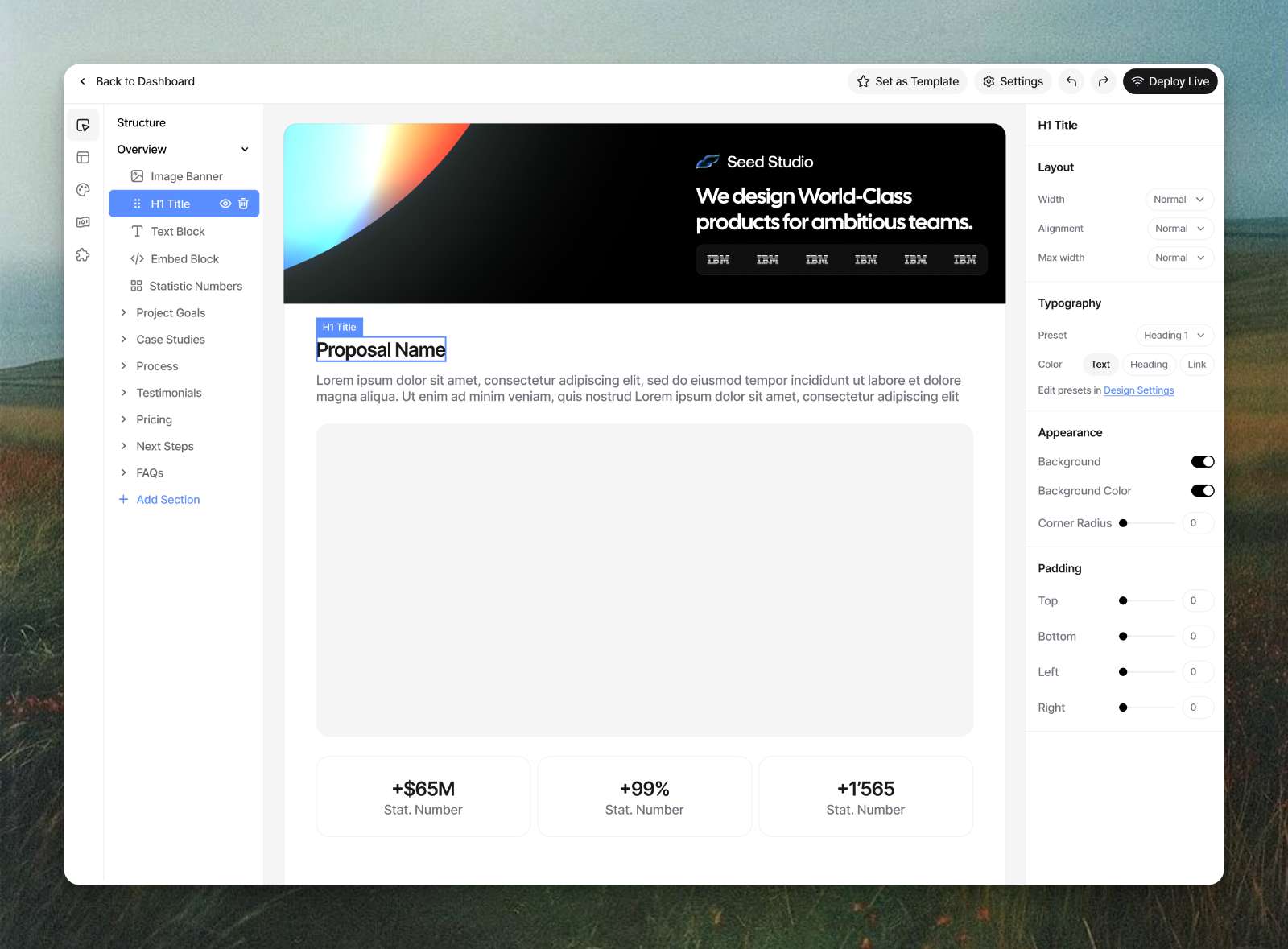
The modern alternative is to make the cover letter the first screen of an interactive, trackable proposal rather than a cover page on a PDF. When the document lives on the web, the same cover letter that built the connection now opens straight into an offer the client can act on without leaving the page:
- You see when the prospect opens it and which sections they actually read, so you follow up at the right moment, with the right message, instead of guessing.
- The client can e-sign the agreement inline (eIDAS-compliant) and pay a deposit via Stripe without printing or wiring anything.
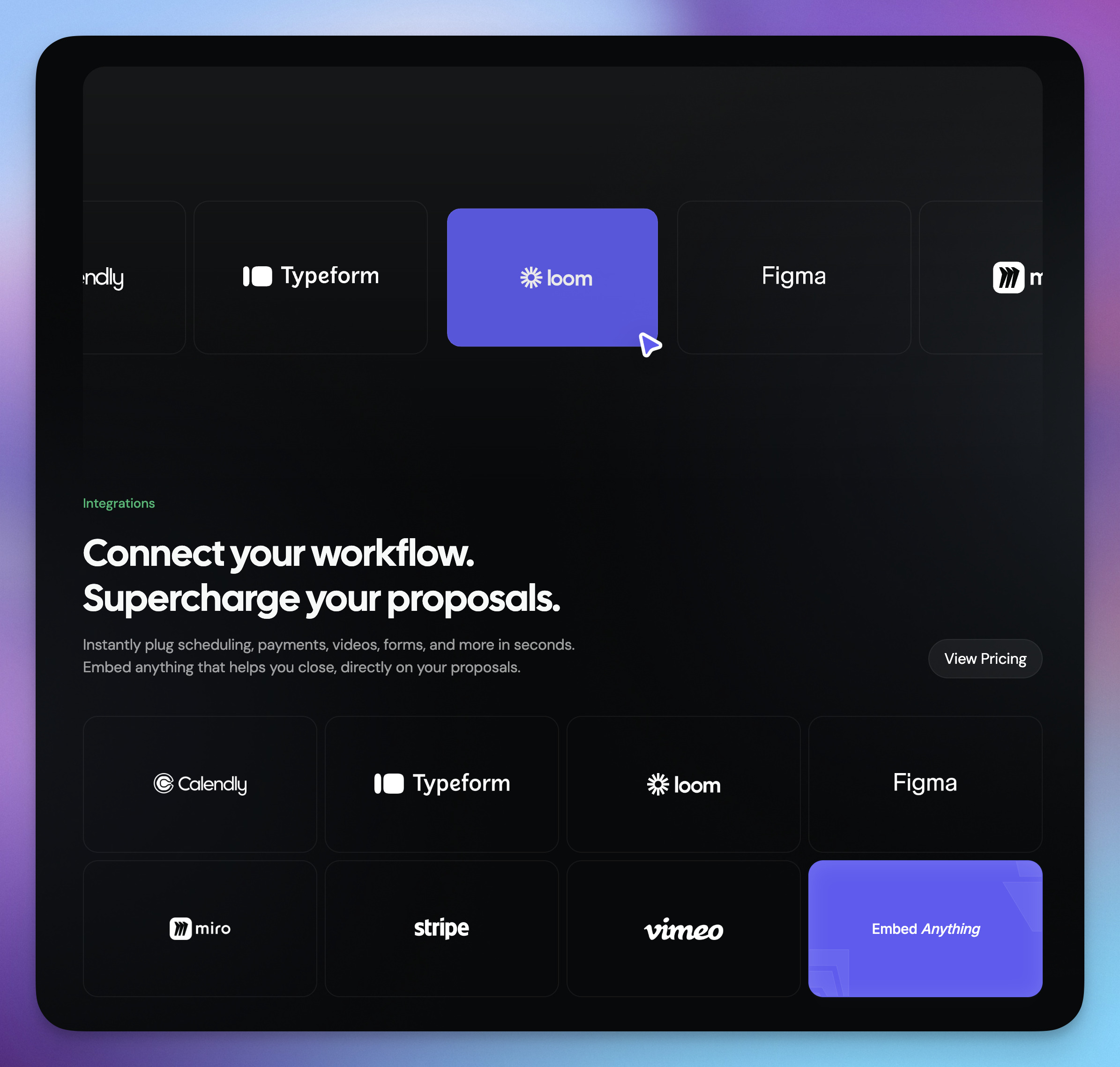
- You can embed a Calendly booker, a Loom walkthrough, or a Notion doc right inside the proposal, turning your "let's hop on a call" CTA into a live button.
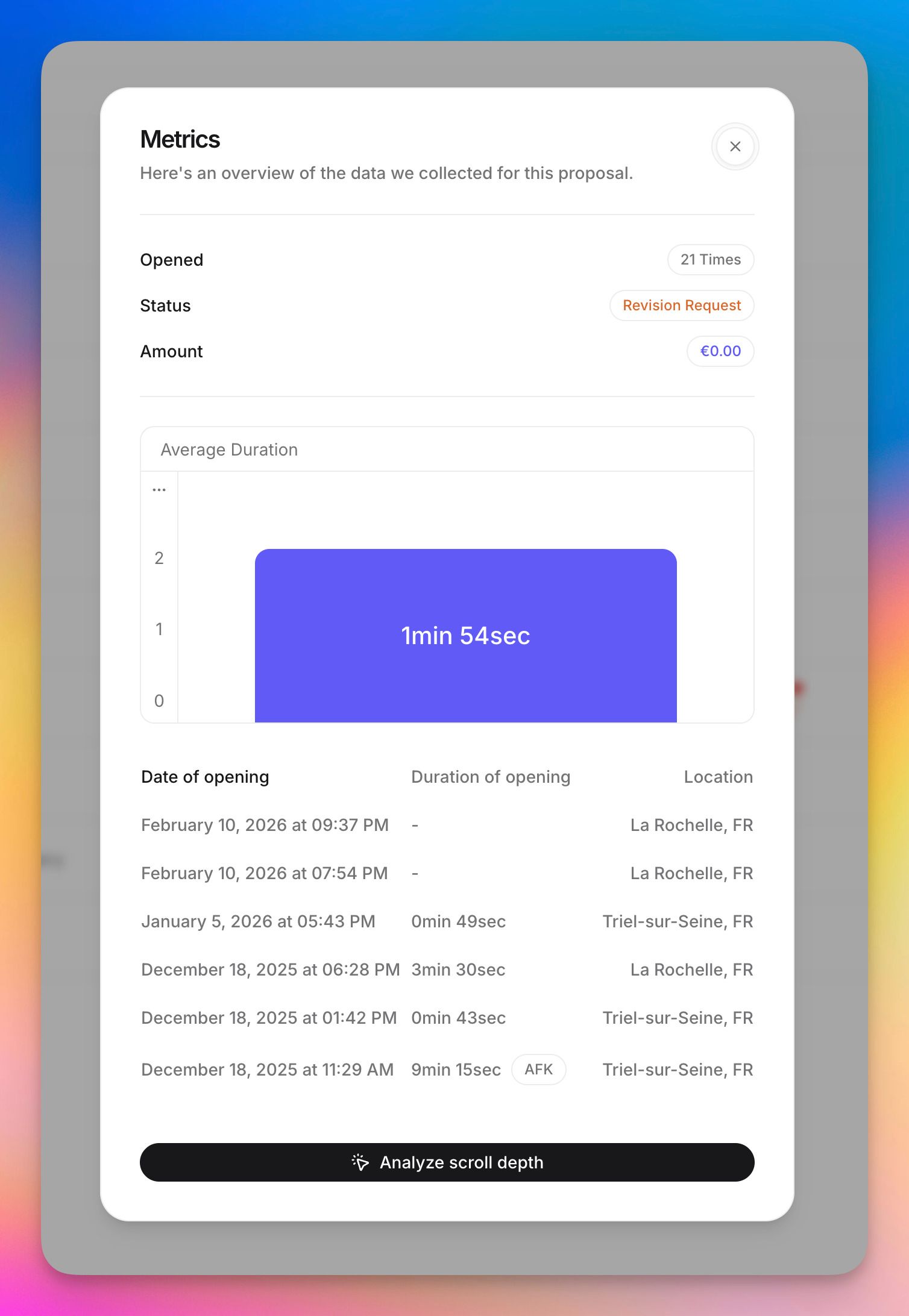
That's the gap between a cover letter that introduces a document and one that opens a deal. Propal is the proposal template software built for exactly this: agencies and freelancers send branded, interactive proposals, cover letter included, and close deals 40% faster by giving clients a richer, action-ready experience than any PDF can.
You don't have to change how you write the cover letter. You change what it leads into.
See it in practice. Start from a branded, interactive proposal template, drop your cover letter on the first screen, and send a proposal your client can read, sign, and pay, all in one link.
→ Browse interactive proposal templates
Conclusion
A proposal cover letter isn't a formality, it's the one page where you stop being a vendor and start being a partner. Get the six steps right (real name, strong opening, problem restatement, solution framing, one proof point, clear next step), keep it to one page, and let the proposal handle the detail. Use the template to draft fast, the annotated example as your quality bar, and the cover-letter-vs-proposal table to stop the two from blurring.
Then take the obvious next step: don't bury that great cover letter in a static PDF. Put it on the first screen of a proposal your client can read, sign, and pay in a single link.
Keep building:
→ Try Propal free, turn your cover letter into a proposal that closes
.webp)