.webp)

.jpeg)
 ChatGPT
 Perplexity
 Gemini
 Grok
Grok
 Claude
A consulting proposal template is a reusable document that lays out the client's problem, your proposed approach, scope, timeline, pricing, and terms, so a prospect can read it, agree, and sign. A strong template has eight sections, opens with the client's problem (not your bio), and makes the price easy to say yes to.
If you consult, freelance, or run a small agency, the proposal is where deals are won or lost. The doc itself isn't the work, but a vague, generic, or padded one quietly kills good opportunities. This guide gives you the full structure, a copy-paste consulting proposal template, an annotated consulting proposal example, a step-by-step writing process, and a clear take on pricing. By the end you'll know exactly what to include in a consulting proposal, and what to cut.
What is a consulting proposal?
A consulting proposal is a document you send to a prospective client that explains the problem you'll solve, how you'll solve it, what you'll deliver, by when, and for how much. It's written from the seller's side, you, the consultant, and its job is to turn a discovery conversation into a signed engagement.
It sits between two things people often confuse it with:
- A proposal is persuasive. It makes the case for working with you, frames the value, and asks for a decision. It can include some scope and pricing, but it's still a pitch.
- A statement of work (SOW) is operational. It's the detailed, contractual definition of deliverables, responsibilities, milestones, and acceptance criteria. The SOW (or the contract) usually comes after the prospect says yes to the proposal, though for smaller engagements, a tight proposal can double as both.
So when someone asks "consulting proposal vs SOW?", the short answer is: the proposal sells the engagement, the SOW governs it. On a 5,000-word RFP you'd keep them separate. On a $15K agency project, your proposal often carries enough scope detail to act as the agreement, with the contract attached.
The point of the proposal is not to describe everything you could do. It's to make one specific path forward feel obvious, low-risk, and worth the price.
What every consulting proposal should include: the 8 essential sections
Almost every winning consulting proposal, whether it comes from a solo consultant or a McKinsey-style firm, maps to the same eight building blocks. Both HubSpot's guide to writing a consulting proposal and monday.com's breakdown of consulting proposal components converge on a near-identical skeleton. Here it is, with what goes in each and a micro-example.
This is the consulting proposal structure to memorize:
1. Cover / title page
A clean cover with the project name, the client's name, your name or brand, and the date. Small thing, big signal: a tailored cover ("Growth Audit Proposal : prepared for Northwind Studio") tells the prospect this wasn't copy-pasted from the last deal.
2. Executive summary
The most-read and most-skipped-over section. In two or three sentences, restate the client's goal and your headline recommendation. Example: "Northwind wants to double inbound demo requests within two quarters. We propose a 90-day conversion sprint focused on your three highest-traffic pages, projected to lift demo conversion meaningfully without new ad spend." Write it last, put it first.
3. Problem statement / context
Prove you listened. Mirror the client's situation in their words, the pain, the stakes, what's been tried. Buyers green-light consultants who clearly get the problem before they pitch a solution. Skip this and your proposal reads like a brochure.
4. Proposed approach & methodology
Your plan of attack, in phases. This is where you show how you think, not just what you'll do. Name your phases (Discover → Build → Launch → Measure), explain the logic, and tie each phase back to the client's goal. Top firms win here by making the method feel rigorous and repeatable.
5. Scope & deliverables
The anti-scope-creep section. List concrete deliverables ("3 landing page redesigns, 1 analytics dashboard, 2 strategy workshops") and, just as important, an explicit out of scope line. Ambiguity here is what turns a profitable project into a slow bleed.
/ima
6. Timeline & milestones
A simple phased timeline with dates or week numbers and the milestone that closes each phase. It answers "when do I see results?" and sets expectations before the kickoff, not during it.
7. Pricing & terms
The number, the model (fixed, retainer, or value-based), what's included, payment schedule, and basic terms (validity, deposit, revision policy). We go deep on this below, it deserves more than a line item.
8. About you + social proof + next steps
A short credibility block (relevant results, two-line case study, logos), then one unmistakable next step: book the kickoff, sign here, or pay the deposit. Don't end on "let us know your thoughts." End on an action.
Want a head start instead of a blank page? Browse Propal's ready-to-edit proposal templates built around exactly these eight sections, then make them yours.

Consulting proposal template (copy-paste)
Here's the full text consulting proposal template, block by block. Copy it, drop it into Google Docs, Word, or a Propal proposal, and replace the bracketed fields. It works as a consulting proposal template Word users can paste straight into a .docx, and it's a genuinely consulting proposal template free of charge, no email gate.
[YOUR LOGO]

CONSULTING PROPOSAL
Prepared for: [Client name / company]
Prepared by: [Your name / agency]
Date: [Date]   ·   Valid until: [Date + 30 days]

— — —

1. EXECUTIVE SUMMARY
[Client] wants to [primary goal]. We propose [headline recommendation] over
[timeframe], focused on [scope in one phrase]. The expected outcome is
[result tied to a business metric].

2. THE SITUATION
Today, [Client] is facing [problem in the client's own words]. This matters
because [business stakes]. You've already tried [prior attempt], but
[why it fell short]. Left unaddressed, [cost of inaction].

3. OUR APPROACH
We'll work in [N] phases:
  • Phase 1 — [name]: [what happens, why]
  • Phase 2 — [name]: [what happens, why]
  • Phase 3 — [name]: [what happens, why]
Each phase ends with [a concrete checkpoint] so you always know where things stand.

4. SCOPE & DELIVERABLES
In scope:
  • [Deliverable 1]
  • [Deliverable 2]
  • [Deliverable 3]
Out of scope (available as add-ons):
  • [Excluded item 1]
  • [Excluded item 2]

5. TIMELINE
  • Week 1–[x]: Phase 1 → [milestone]
  • Week [x]–[y]: Phase 2 → [milestone]
  • Week [y]–[z]: Phase 3 → [milestone]
Total: [duration]. Start date: within [N] days of signature.

6. INVESTMENT
[Pricing model: fixed fee / monthly retainer / value-based]
  • [Package or phase] .......... [Amount]
  • [Package or phase] .......... [Amount]
Total: [Amount]
Payment: [e.g. 50% deposit on signature, 50% on final delivery].

7. ABOUT [YOU / YOUR AGENCY]
[1–2 sentences on relevant experience.] Recent results: [client] —
[outcome]. [Logo strip or testimonial.]

8. NEXT STEPS
Ready to start? [Sign below / book your kickoff call here / pay the deposit].
This proposal is valid until [date].

[Signature block / accept button]
Use it as a starting point, not a script. The bracketed fields are where you earn the deal, the more specific they are to this client, the higher your close rate.
Consulting proposal example (annotated)
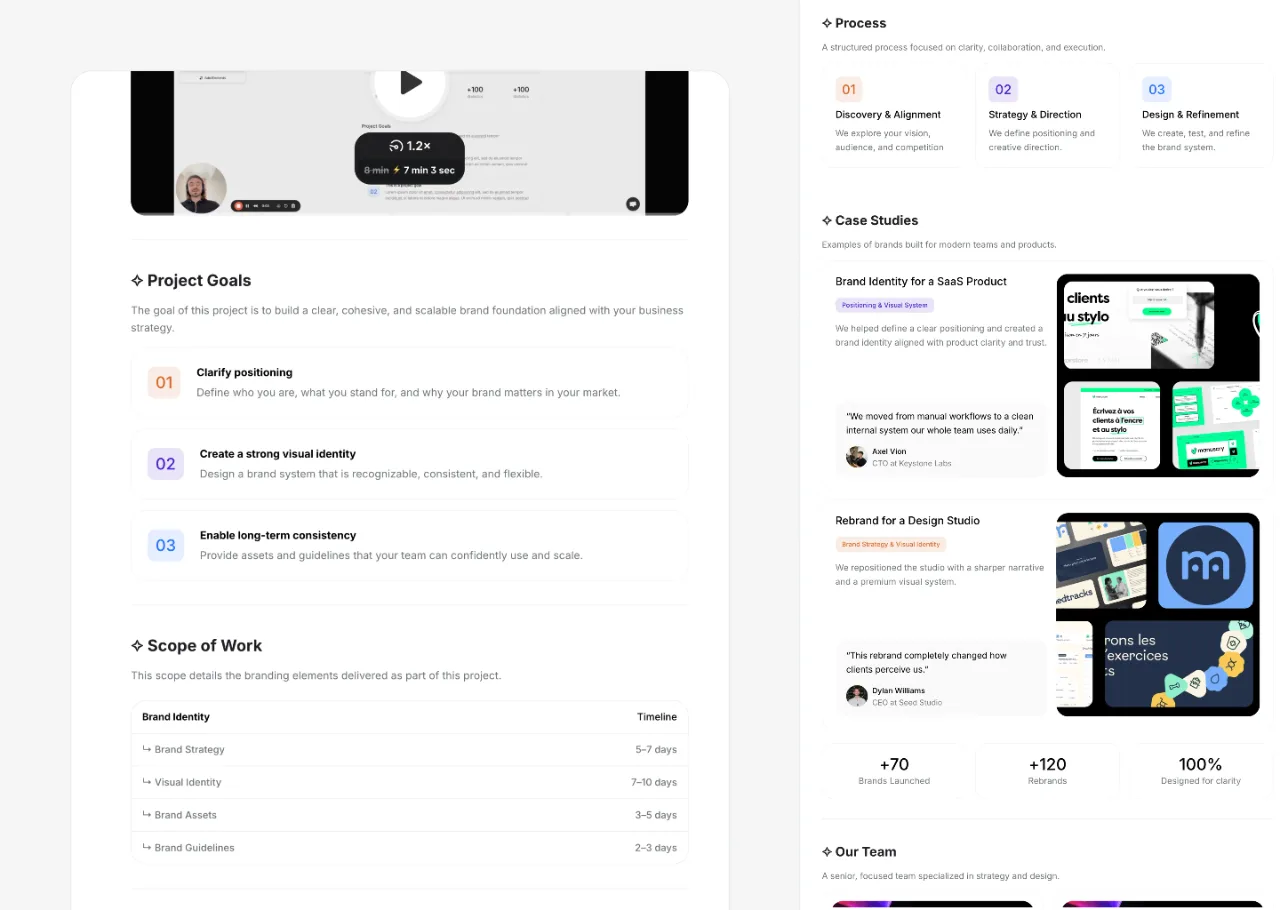
A template shows the shape; an example shows the judgment. Here's a short, realistic consulting proposal example for a freelance growth consultant pitching a SaaS company, with notes on what works and what would lose the deal.
Prepared for: Northwind Studio · Prepared by: Maya R., Growth Consultant · Date: July 2026
Executive summary. Northwind wants to double inbound demo requests within two quarters without increasing ad spend. I propose a focused 90-day conversion sprint on your three highest-traffic pages, homepage, pricing, and the top blog post, with a target of meaningfully lifting demo conversion through copy, layout, and a clearer call to action.
✅ Why it works: specific goal, specific constraint ("without ad spend"), specific scope (three pages). No fluff.
The situation. You're getting solid traffic but the demo-request rate has been flat for three quarters. Two redesigns didn't move it because they changed the look, not the message. The cost: every month of flat conversion is pipeline you've already paid to attract but aren't capturing.
✅ Why it works: mirrors the client's history and names the real cost. ❌ What would lose the deal: a generic "conversion is important for SaaS companies" paragraph that could apply to anyone.
Approach. Phase 1: Diagnose (week 1–2): heatmaps, session review, message audit. Phase 2: Rebuild (week 3–8): rewrite and restructure the three pages. Phase 3: Test & hand off (week 9–12): A/B test, document, train your team.
✅ Why it works: phased, time-boxed, ends with knowledge transfer so the client isn't dependent forever.
Scope. In: 3 page rewrites, 1 message framework, 2 working sessions. Out (add-on): paid-ads overhaul, full rebrand, ongoing retainer.
✅ Why it works: the "out of scope" line is the cheapest insurance against scope creep you'll ever write.
Investment. Fixed fee: $9,000. 50% to start, 50% on hand-off.
❌ What would lose the deal: burying the price on page 9, or padding it with vague "strategy hours" nobody can verify.
Next step. Sign below to lock a start date in the next two weeks.
The lesson: every section is doing a job. The moment a paragraph stops serving the client's decision, cut it.
How to write a consulting proposal step by step
Here's how to write a consulting proposal that actually closes, six steps, in order. The trap is starting at "open a template and fill it in." The real work happens before you type a word.
- Run a proper discovery call first. You can't write a sharp proposal from a vague brief. Get the goal, the metric, the constraints, the budget range, and who signs. If you skip this, every later step is a guess.
- Frame the problem before the solution. Write the situation section first, in the client's language. If you can't articulate their problem better than they can, you're not ready to pitch.
- Define scope and deliverables tightly. List exactly what's in, what's out, and what an add-on costs. Scope is where margin lives, protect it.
- Choose a pricing model and set the number. Decide between fixed fee, retainer, or value-based (see the next section), then anchor the price to the outcome, not to your hours.
- Write the proposal, summary last. Fill the eight sections, keep paragraphs short, and write the executive summary at the very end when you actually know what you're proposing.
- Send it, then follow up, and track engagement. A proposal isn't "sent and forgotten." Follow up within 48 hours. If your proposal tells you when the prospect opened it and which section they reread, you'll follow up at exactly the right moment instead of guessing.
How long should a consulting proposal be? Long enough to make the decision easy, short enough that a busy buyer reads all of it. For most agency and freelance deals, two to six pages is the sweet spot. A six-figure or public-sector engagement may run longer, but length is never the goal; clarity is.
How to price a consulting proposal
Pricing is the section that wins or loses the most deals, and it's the one most templates skip. There are three common models, and the right one depends on how predictable the work is and how clearly you can tie it to a business outcome.
A few rules that hold across all three:
- Anchor to outcome, not hours. "$9,000 to lift demo conversion" lands better than "60 hours at $150." Buyers pay for results, not timesheets.
- Make the number easy to say yes to. Offer a payment schedule (a deposit plus a milestone payment) so a $12K project doesn't feel like a single scary line.
- Kill scope creep at the source. Your explicit "out of scope" list plus an add-on price list means changes become new revenue, not free work.
- Present one recommended option (you can add a lighter and a premium tier), but never bury the price. If a prospect has to hunt for the number, you've already lost momentum.
Done right, pricing isn't the awkward part of the proposal, it's the part that signals confidence.
Static doc vs interactive proposal: why consultants switch in 2026
Almost every consulting proposal template you'll find online ships as a static file: a Word doc, a PDF, or a slide deck. That format works, but it has blind spots. You email a PDF and then go dark: you don't know if it was opened, which section lost the prospect, or whether the price page scared them off. Signing means printing or a separate e-sign tool. Getting paid means a third document and a wait.
An interactive proposal closes those gaps. Instead of a file, the proposal lives as a web page the client opens in a browser:
This is the gap Propal is built for. Your consulting proposal becomes a web page that tracks engagement section by section, signs with compliant e-signature, takes the deposit via Stripe, and embeds a Calendly link to book the kickoff or a Loom to pitch the approach. You see exactly when a prospect reread the pricing, so you follow up at the perfect moment. That's how teams using interactive proposals close deals 40% faster with Propal than with email-and-PDF.
It's not about replacing the eight-section structure, it's about putting that structure in a format that tracks, signs, and gets paid. If you only send a proposal once a quarter, a Word file is fine. If proposals are how you make a living, the interactive format pays for itself fast.
See your next proposal close itself. Start from a consulting proposal template in Propal, trackable, signable, payable.
Conclusion
A great consulting proposal template gives you the eight-section structure; your judgment fills it in. Open with the client's problem, define scope tightly, make the price easy to say yes to, and end on one clear action. Use the copy-paste template above, study the annotated consulting proposal example, follow the six-step writing process, and pick the pricing model that fits the work. Then decide on format: a static Word or PDF doc is fine for the occasional deal, but if proposals are how you win business, an interactive, trackable, signable, payable proposal will close more of them, faster.
Keep building:
- Business proposal template
- Sales proposal template
- Project proposal template
- AI proposal generator
- Propal proposal templates
Build your next consulting proposal in Propal, free for 7 days →
.webp)