.webp)

.jpeg)
 ChatGPT
 Perplexity
 Gemini
 Grok
Grok
 Claude
The best AI proposal generator in 2026 depends on what you actually need. Static PDF tools like Venngage and Quillbot are fine for one-off documents. Full SaaS platforms like Proposify and Propal handle the entire sales workflow. Design platforms like Canva work when visuals matter more than copy. For creative agencies and freelancers closing B2B deals between $500 and $15K, interactive proposal generators with built-in tracking, e-signatures, and payments consistently outperform PDF-only tools on close rates.
In this guide, we compare the 8 best AI proposal generators of 2026, free and paid, design-led and sales-led, and show you how to pick the right one for your workflow. We also cover what AI proposal generators actually do, where they fall short, and whether ChatGPT can replace them.
Key takeaways
- Best for agencies and freelancers → Propal (interactive proposals with tracking, e-signatures, Stripe payments)
- Best for sales teams → Proposify, but note their AI Proposal Generator is in waitlist mode as of May 2026
- Best truly free option → Quillbot or Venngage
- Best for design-led decks → Canva Magic
- ChatGPT can draft proposals but lacks templates, tracking, and payment features
What is an AI proposal generator?
An AI proposal generator is a tool that uses large language models (LLMs) to draft business, sales, or project proposals from a simple text prompt, typically generating sections like executive summary, scope, pricing, timeline, and call to action in under 60 seconds.
Under the hood, these tools combine an LLM (often GPT-4 or Claude) with proposal-specific templates and prompt engineering. You give the tool a short description of your project, your client, and your goals. It returns a structured first draft you can edit, brand, and send.
Most AI proposal generators produce one of three output formats: a static PDF (Venngage, Quillbot, Template.net), a slide deck (Visme, Canva), or a web-based interactive proposal that the client opens in their browser (Propal, Proposify). The output format matters more than people realize, a PDF can't track when the client opens it, request a signature, or collect payment.
There's a subtle distinction worth noting: an AI proposal generator typically builds the full document end-to-end, while an AI proposal writer assists section by section. The lines blur in practice.
Can AI really write a winning proposal?
Yes, but with caveats. AI can generate solid first drafts in seconds, but winning proposals require personalization, brand voice, accurate pricing, and most importantly, a structure that drives the client toward signing. Here's where AI helps and where it doesn't.
What AI does well
Structuring proposals into standard sections, polishing language to sound professional, and saving most of the drafting time. Modern AI tools also handle prompt-to-template matching reliably: feed in "consulting proposal for a SaaS rebrand" and you get a usable scaffold immediately.
What AI gets wrong
Generic copy that reads like every other proposal. Hallucinated pricing or stats that you'll need to verify line by line. Missing brand voice, the tonal nuance that separates your studio from the next one. And almost universally, AI underperforms on complex deal structures: multi-phase scopes, conditional pricing, multi-stakeholder approval chains.
When to use AI versus writing from scratch
Use AI for the structure and most of the draft. Reserve human writing for the parts that actually close deals: the discovery summary that proves you understood the brief, the case study that mirrors the client's situation, and the closing argument that addresses their specific risk. According to the Salesforce State of Sales report, personalization is the top driver of B2B win rates, and that's still the human's job.
The 8 best AI proposal generators in 2026
We compared every tool by what matters for agencies and freelancers actually closing deals: output format, sales-specific features, ICP fit, and honest pricing. Here's the ranking.
1. Propal: Best for agencies and freelancers closing interactive deals

Pricing: Free trial. Plans from $29.99/month. Best for: Digital agencies, design studios, freelance creators with B2B clients in the $500-$15K range.
Propal generates interactive web-based proposals, not PDFs, with AI, then layers in real-time tracking, e-signatures, Stripe payments, and embeds for Calendly, Loom, Notion, and Miro. Built specifically for agencies and freelancers, Propal's core promise is to help close deals 40% faster by giving the client a richer experience than a static document.
The interactive format matters because of how modern B2B clients actually evaluate proposals: they share them with stakeholders, revisit specific sections, and need to take action (booking a call, watching a walkthrough, signing, paying) without leaving the document. A PDF can't do any of that. Propal's AI generates the structure and copy, then you drop in a Calendly booker, a Loom intro, and a Stripe payment link, all live inside the proposal.
- Interactive proposals with Calendly, Loom, Stripe, Notion, and Miro embeds
- Real-time tracking and per-section engagement analytics
- Built-in e-signature and Stripe payments
- Templates purpose-built for creative agencies and freelancers
- Newer to the market than Proposify or PandaDoc
- Premium templates require a paid plan
- Best fit for B2B services, less optimized for product/CPQ use cases
Browse our proposal templates to see the interactive format in action.
2. Proposify: Best for sales teams (AI generator in waitlist)
Pricing: From $19/month. Best for: Mid-market sales teams with an established proposal workflow.
Proposify is the established SaaS proposal platform with electronic signatures, document tracking, integrations with Salesforce and HubSpot, and a substantial content library. The platform has been a category leader for nearly a decade and remains a serious option once you're past the freelance stage and need workflow controls (approval chains, roles and permissions, audit trails).
Note: at the time of writing (May 2026), Proposify's AI Proposal Generator is in waitlist mode, the company describes the feature as "currently being reworked." Their existing manual editor and template library remain fully usable, but the AI piece specifically is gated behind a signup form with no public ETA. If AI generation is the reason you're shopping, you'll need to look elsewhere or wait.
- Mature platform with deep Salesforce integration
- Trusted by mid-market clients like PostMedia, WSI, and BluSky
- Transparent pricing across Basic, Team, and Business tiers
- Full electronic signature and interactive pricing tables (sold separately)
- AI generator not currently usable, sign up to a waitlist instead
- Heavier interface, longer onboarding than newer tools
- No interactive embeds (Calendly, Loom, Notion)
If Proposify's waitlist is blocking your workflow, see our roundup of best Proposify alternatives for tools you can use today.
3. Venngage: Best for design-led one-page proposals
Pricing: Free / Premium from $19/month. Best for: Marketers and consultants who need polished one-pagers fast.
Venngage's AI Proposal Generator builds on its design platform, offering branded templates for business, consulting, marketing, event, and research proposals. The design quality is excellent and the free tier is generous enough that you can produce a real client-ready proposal without paying. Where Venngage shines: visual polish and template variety. Where it falls short: it's a design tool with AI layered on top, not a sales tool with design layered on top, the distinction matters once you start sending proposals at scale.
The AI generation works from a simple prompt and produces a structured proposal you can edit visually. Brand kit, logo, fonts, and colors auto-apply across the design. Output formats include PDF, PNG, PPT, and HTML.
- Strong design templates and brand kit auto-apply
- Generous free tier with no signup gating
- Wide template variety (business, marketing, event, research, brand management)
- Solid social proof: 4.7/5 on G2, 4.6/5 on Capterra
- Output is PDF, PNG, or static HTML, no proposal tracking
- Not optimized for sales close (no e-signature, no payment integration)
- Generic AI copy quality compared to dedicated proposal tools
4. Quillbot: Best for fast project proposal drafts
Pricing: Free / Premium from $9.95/month. Best for: Students, small business owners, and podcasters drafting structured proposals.
Quillbot's AI Project Proposal Generator is part of a broader AI writing suite that includes a paraphraser, grammar checker, AI detector, summarizer, and translator. The proposal generator specifically excels at academic, research, grant, and small-business proposals, anywhere you need a clean structured first draft fast. The trust score on Trustpilot is 4.8/5 with over 12,000 reviews, and the company integrates with Google, Microsoft Word, macOS, and Chrome via 6M+ extension users.
For B2B sales proposals specifically, Quillbot is more of a generic AI writer than a purpose-built tool. It produces clean copy but lacks the sales-specific structure (problem framing, value-based pricing, close-oriented CTAs) that paid proposal tools embed by default.
- Free to use with no signup required for basic generation
- Massive social proof and trust signals (12K+ Trustpilot reviews)
- Sample prompts annotated to help beginners
- Works across browser, macOS, Windows, Word add-in
- No tracking, signature, or payment features
- No sales-specific templates, output reads academic
- Best for project/research proposals, weaker for B2B sales
5. Canva Magic: Best for visually-driven proposals
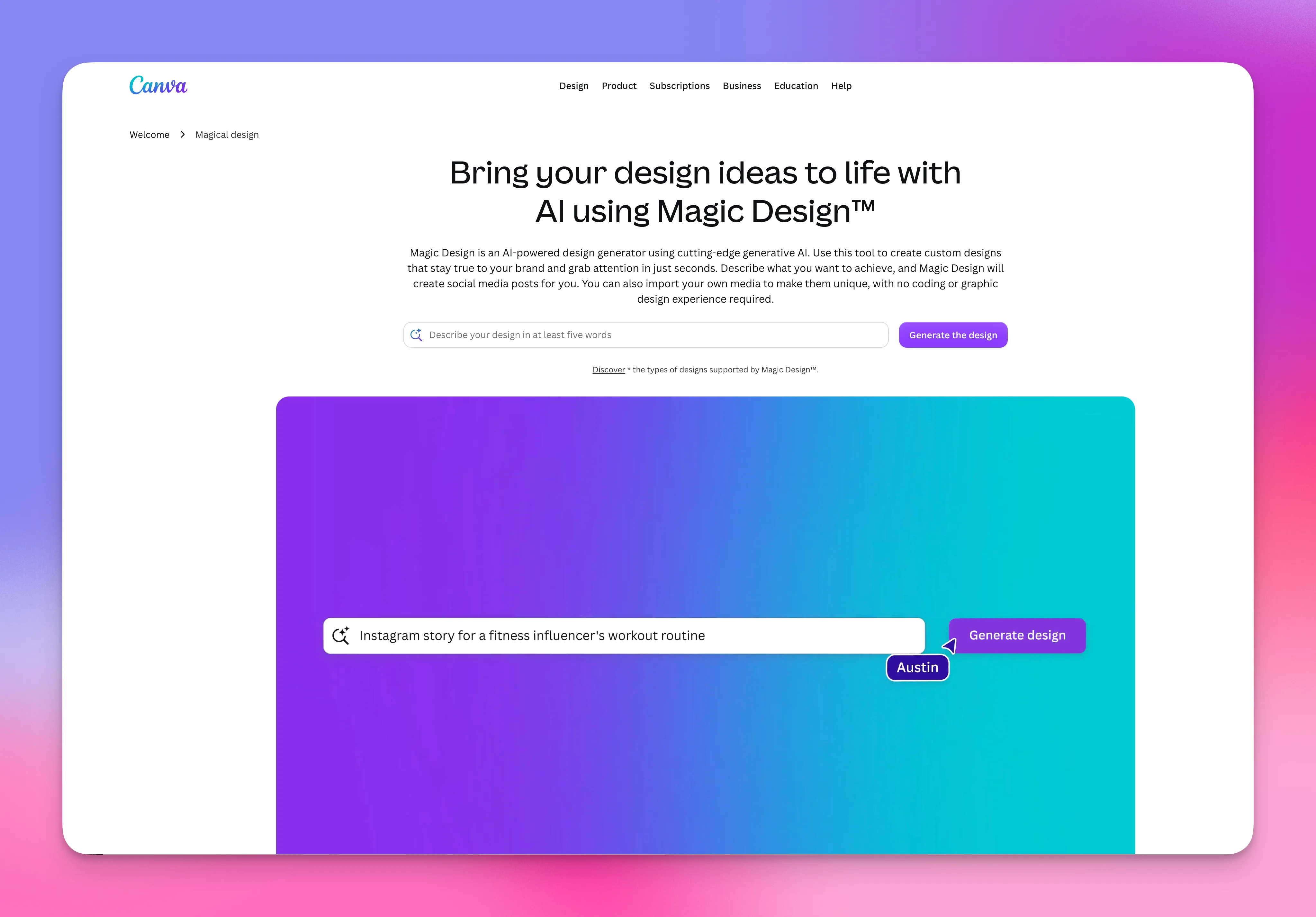
Pricing: Free / Pro $14.99/month. Best for: Creative agencies and design freelancers who prioritize visual polish.
Canva's Magic Studio brings AI-powered proposal generation into Canva's design ecosystem. It's excellent for visually-driven proposals where design matters more than copy depth. If your selling point is your aesthetic, Canva wins on visuals.
- Best-in-class design and template library
- Brand kit support across all assets
- Familiar interface for designers
- AI generation is shallower than dedicated proposal tools
- Export-only, no tracking or e-signature
- Not sales-optimized (no payment, no analytics)
6. Template.net AI: Best for instant template fills
Pricing: Free / Pro from $8/month. Best for: Solopreneurs who need a quick fill with no learning curve.
Template.net's free AI proposal generator turns voice or text prompts into editable proposals. No signup required for basic use. The output is fast but generic, fine for a low-stakes proposal, less so for high-value deals.
- No signup required for the basic tool
- Voice prompts supported
- Many template categories beyond proposals
- Generic copy quality
- No SaaS workflow features
- Heavy ads on the free tier
7. Visme AI: Best for proposal slide decks
Pricing: Free / Standard $12.25/month. Best for: Presenters who use proposals as slide decks during live pitches.
Visme's AI Business Proposal Generator is presentation-focused. It's ideal for proposals delivered live or via screen-share rather than sent async to a client to review and sign.
- Slide deck format works for live pitches
- Decent free tier
- Strong infographic and data viz tools
- Static output, no async tracking
- Not built for self-serve sales flows
- Limited AI depth compared to dedicated tools
8. PandaDoc AI: Best for high-volume enterprise sales teams
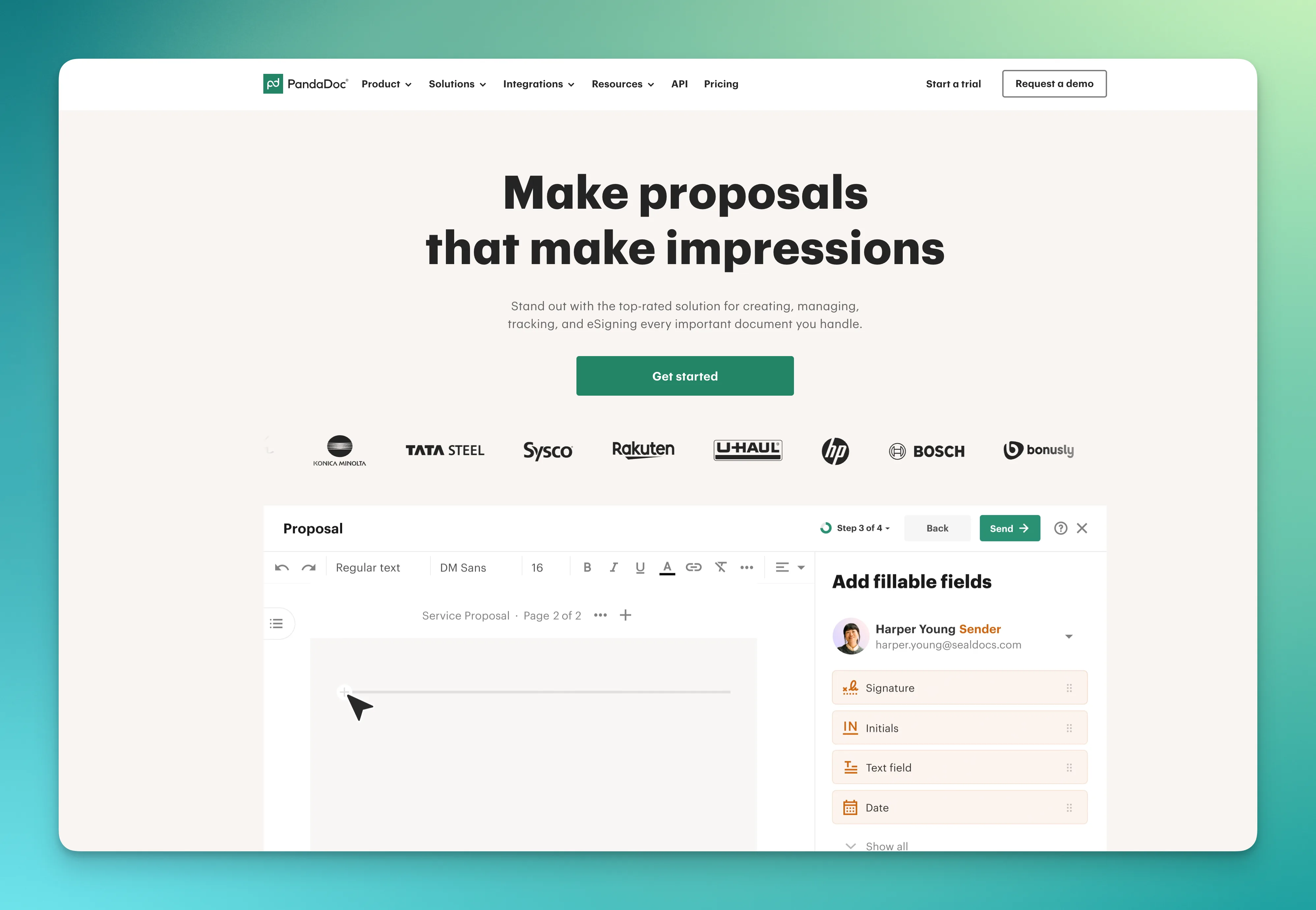
Pricing: Essentials $19/month. Business $49/user/month. Best for: Enterprise sales teams managing high-volume RFP responses and CPQ.
PandaDoc is the enterprise standard for proposal automation, with AI features layered on top of its document workflow. Built for sales teams with content libraries, CRM integration, and CPQ (configure-price-quote) needs.
- Enterprise-grade reliability
- Full Salesforce integration
- CPQ and quoting features
- Overkill for freelancers and small agencies
- Pricing scales fast with team size
- Less design flexibility than Canva or Propal
Looking at other tools beyond AI specifically? Compare Qwilr alternatives and the broader proposal software landscape.
Ready to try interactive AI proposals? Propal generates branded proposals in minutes with built-in tracking, e-signatures, and Stripe payments. Start free, no credit card required. Browse interactive proposal templates →
How to choose the right AI proposal generator
The right tool depends on your deal volume, ICP, and how sales-led your process actually is. Here's the breakdown by use case.
For freelance creators (1-3 deals per month)
You need fast first drafts and the ability to look professional without a design team backing you. Quillbot or Venngage's free tier handles drafting. If your deals are above $2K, upgrade to Propal's free trial to add tracking and e-signatures, knowing the moment a prospect opens your proposal, which sections they spend time on, and whether they shared it internally is worth more than a polished PDF. At freelance volume, the time savings of AI generation matter less than the win-rate uplift of a trackable, signable proposal.
For digital agencies (10-30 deals per month)
You need template reuse, brand consistency, and visibility into what's happening between send and close. Propal fits agencies natively with interactive proposals, embed support for Calendly and Loom, and per-section proposal tracking so you know which slide the prospect re-read three times. Proposify works once their AI generator is live again. PandaDoc is overkill at this stage unless you already use Salesforce.
For consultants (high-value bespoke proposals)
You're sending fewer but bigger proposals, typically $20K+ engagements. Volume matters less than personalization. Venngage handles the design with strong templates and the AI handles a meaningful portion of the draft; you handle the rest. For high-trust enterprise consulting, the personal touch outranks any AI feature. AI generation here is a productivity tool, not the entire workflow.
For SaaS sales teams (high-volume, CRM-integrated)
PandaDoc or Proposify enterprise tier. You need Salesforce or HubSpot integration, content libraries the team can pull from, approval workflows for managers to sign off on discounts, audit trails for compliance, and CPQ if you sell configurable products. AI is one feature among many, the bigger value is workflow automation across the team.
How to write a winning AI prompt for proposals
The quality of your AI-generated proposal is mostly determined by the prompt. A vague prompt produces a vague proposal that you'll spend an hour fixing. A precise prompt produces a draft that's near-ready in under a minute. Here's a template that works across every tool in this list.
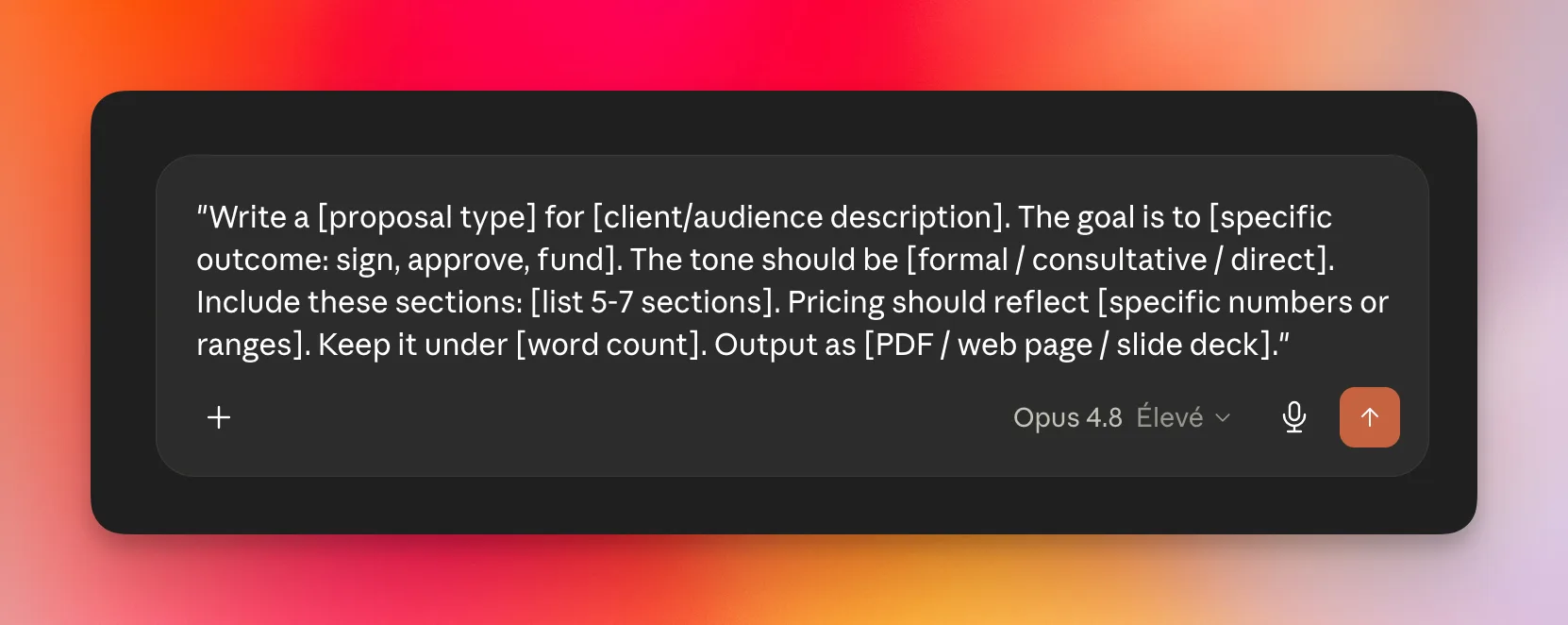
Prompt template:
"Write a [proposal type] for [client/audience description]. The goal is to [specific outcome: sign, approve, fund]. The tone should be [formal / consultative / direct]. Include these sections: [list 5-7 sections]. Pricing should reflect [specific numbers or ranges]. Keep it under [word count]. Output as [PDF / web page / slide deck]."
The five variables that move output quality the most: audience specificity (named role and industry beats "client"), outcome clarity (a number to sign beats "win the deal"), tone constraint (one adjective beats free-form), section list (named sections beat "standard proposal"), and length cap (forces the AI to prioritize).
Three quick examples you can copy:
- "Write a branding proposal for a Series A SaaS startup launching a rebrand. Goal: sign a $25K engagement. Tone: confident, design-led. Include scope, deliverables, timeline, pricing, and risks. Keep it under 1,500 words."
- "Draft a development proposal for a 6-week mobile app build for a fintech client. Tone: precise, technical. Include scope of work, sprint plan, team composition, deliverables, and milestone payments. Cap at 2,000 words."
- "Generate a marketing retainer proposal for a DTC e-commerce brand doing $5M ARR. Goal: $8K/month retainer signed. Include strategy summary, monthly deliverables, KPIs, team commitment, and cancellation terms. Tone: direct and metric-driven."
Limitations of AI proposal generators
AI proposal generators are tools, not magic. Most vendor pages won't tell you this, but before betting your sales pipeline on one, here's what they consistently struggle with, and what to do about it.
- Hallucinated pricing and facts. AI fabricates numbers if you don't give it exact pricing data. We've seen generated proposals quote "$12,500" when the actual scope was $25,000, and inserted timelines that don't match the project complexity. Always verify every dollar amount, date, and quantitative claim before sending. Treat the AI draft as a junior team member's first attempt, not a final document.
- Generic brand voice. AI defaults to corporate-bland ("we are excited to propose," "leverage best practices," "drive maximum value") unless you provide writing samples or detailed tone instructions. For boutique services, this is a real liability, clients can detect AI templates within the first paragraph, and that detection erodes trust.
- Complex deal structures break it. Multi-phase scopes with conditional milestones, retainer-plus-project hybrid pricing, multi-stakeholder approval chains, and bespoke legal terms tend to produce confusing or incomplete output. The more nuanced your deal, the less help AI provides.
- Compliance and legal language. AI can produce non-compliant clauses around GDPR, MSAs, IP assignment, SLAs, and data residency. The output reads professional but may not be legally enforceable. Always run high-stakes proposals past a human reviewer (ideally a lawyer for deals above $50K).
- The personal touch. A community discussion on Reddit recently surfaced what experienced closers already know: clients can tell when a proposal was AI-generated and unedited. For high-trust, high-value work, this hurts conversion more than the time savings help.
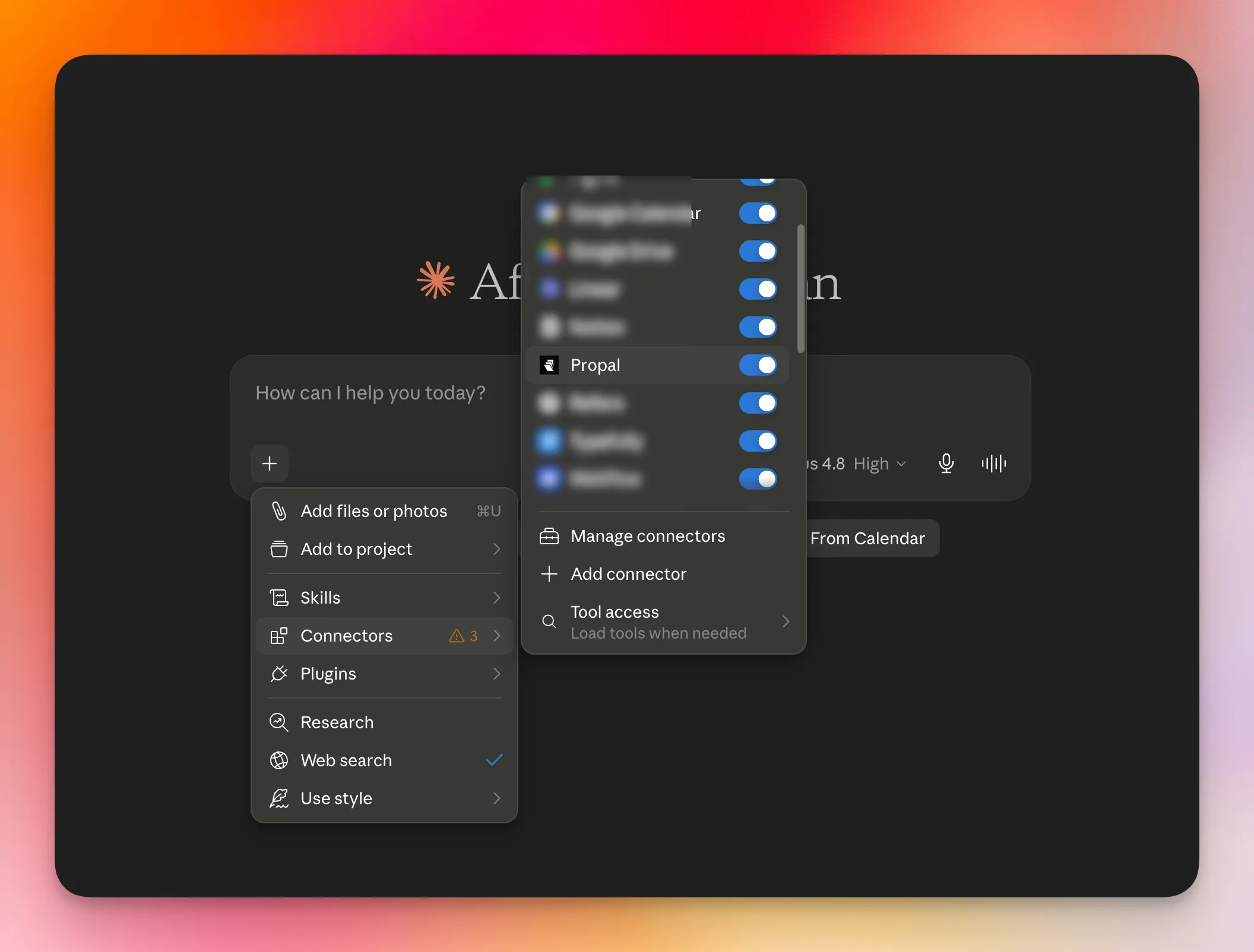
Can ChatGPT write a proposal?
Yes, ChatGPT can write a proposal, but it's not designed for it. Here's the honest comparison.
Use ChatGPT capabilities for brainstorming and rough drafts. Use a dedicated AI proposal generator when you're actually sending the proposal to a client and need tracking, signature, or payment.
What are the three C's of proposal writing?
The three C's of proposal writing are Clarity, Conciseness, and Compellingness, and AI tools amplify or undermine each depending on how you use them.
Clarity is about structure: visible headers, scannable sections, a logical flow from problem to solution to pricing. AI excels at structure. Every tool in this list will produce a clearly organized first draft.
Conciseness is about word count and signal-to-noise. AI tends to over-write. Edit aggressively after generation. Cut every sentence that doesn't move the reader toward signing.
Compellingness is about persuasion: case studies that mirror the client's situation, language that echoes their own words, and a closing argument that addresses their specific risk. This is where AI consistently underperforms, and where human writing still wins deals.
How AI proposal generators are evolving in 2026
The category is moving fast, and the gap between the leaders and the rest is widening. Four trends shape what these tools will look like by 2027.
- Native interactive proposals. PDFs are slowly dying for B2B sales use cases. Web-based proposals with live embeds (Calendly bookers, Loom walk-throughs, Stripe payment buttons, Notion docs, Miro boards) are becoming the new default for SaaS and creative agencies. The interactive format gives clients a richer evaluation experience and gives sellers actual telemetry on engagement. See interactive proposals for a deep dive on the format.
- AI plus CRM integration. Tools are pulling client context directly from Salesforce or HubSpot to personalize automatically, pulling industry, deal stage, past interactions, and even sentiment from email threads. Proposify and PandaDoc lead here; expect every serious tool to follow within 12 months.
- Multimodal generation. Voice prompts produce proposals. Auto-generated video walkthroughs embed in the proposal. Image upload of a hand-drawn scope becomes a structured deliverables section. Template.net experiments with voice input today, and OpenAI/Anthropic native multimodal models make this trivially cheap to adopt.
- Agentic AI workflows. Autonomous follow-up reminders when proposals go unread for X days. Automatic renegotiation suggestions when prospects stall on pricing. AI-drafted answers to objections that arrive via email. According to the HubSpot State of Marketing report, follow-up automation has a measurable impact on close rates in B2B sales; AI agents that act on behalf of the seller will compound this materially over the next 18 months.
Conclusion
The right AI proposal generator depends on whether you're sending a one-off proposal or running a sales engine. For freelancers and small agencies, free tools like Quillbot and Venngage handle one-off drafts. For agencies and consultants closing interactive B2B deals, dedicated platforms like Propal add the tracking, e-signature, and payment features that actually move deals forward. Start with the free option that fits your use case, and upgrade only when the workflow becomes the bottleneck, not the writing.
.webp)