.webp)

.jpeg)
 ChatGPT
 Perplexity
 Gemini
 Grok
Grok
 Claude
A business proposal is a persuasive document used to win clients, secure funding, or pitch projects. It must clearly identify the client's problem, outline a tailored solution, and present a clear budget. The right template depends on your industry, deal size, and whether you need a static PDF, a Word document, or a web-based interactive proposal with tracking, e-signature, and payment built in.
This guide gives you 10 free business proposal templates organized by use case (one-pager, startup, marketing, consulting, web design, catering, cleaning, café, sales letter, interactive), a 7-step guide to write your proposal from scratch, the 8 essential sections that every winning proposal needs, an honest take on whether ChatGPT can write a proposal, and the difference between static and interactive formats.
Key takeaways
- 8 essential sections every business proposal needs (title page to signature)
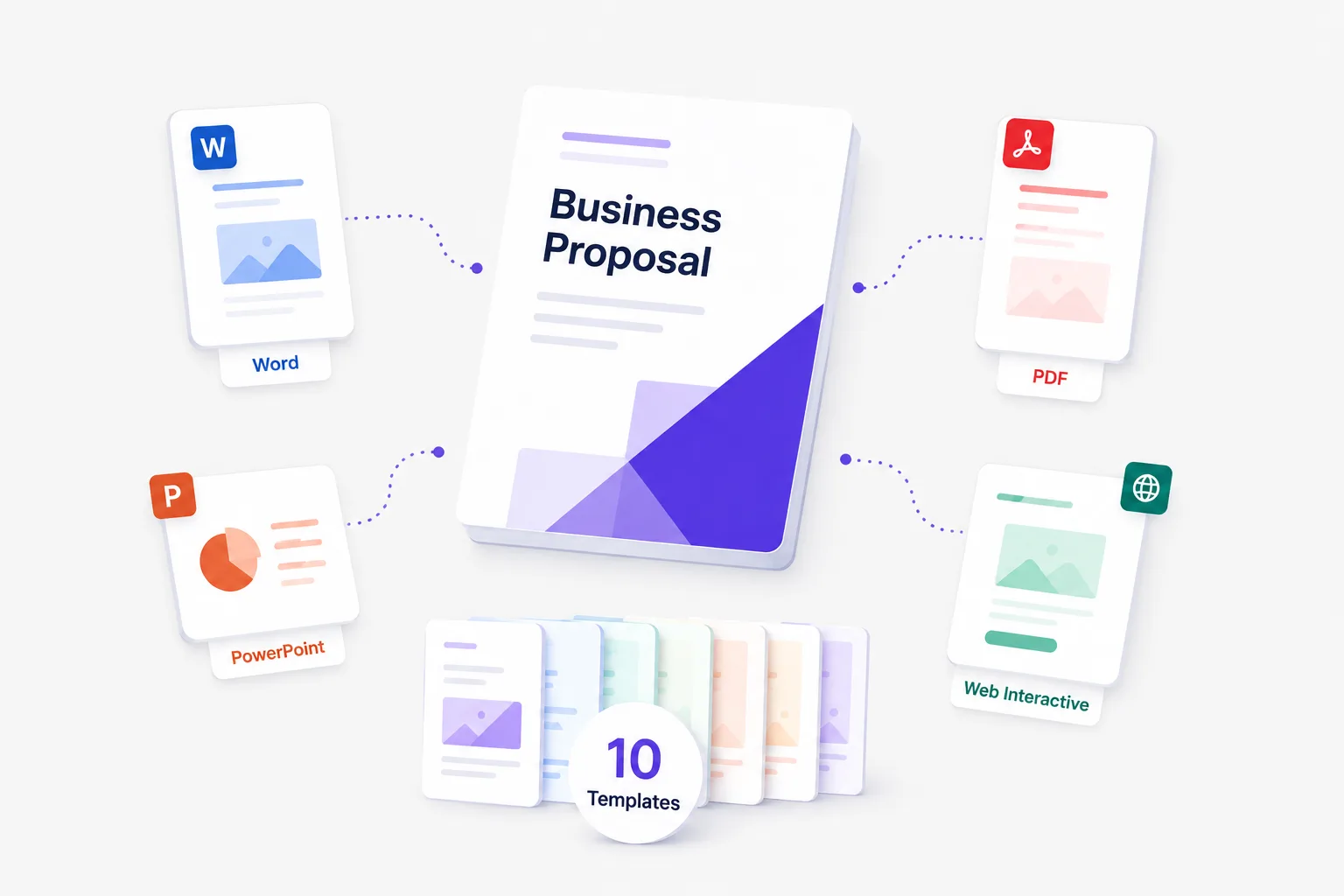
- 10 free templates across Word, PDF, PowerPoint, Google Docs, and web interactive formats
- 7-step writing process from research to polished proposal
- The 3 C's of proposal writing: Clarity, Conciseness, Compellingness
- Interactive proposals consistently outperform static PDFs on conversion for deals above $5K
What is a business proposal?
A business proposal is a persuasive document used to win clients, secure funding, or pitch projects to decision-makers. It goes beyond a simple quote or estimate: it tells a complete story by identifying the client's problem, outlining a tailored solution, demonstrating your qualifications, and presenting clear pricing, all in a single, structured document.
Business proposals fall into three categories. Solicited proposals respond to a formal Request for Proposal (RFP) issued by the client. Informally solicited proposals follow an unscripted conversation where the prospect asked you for a proposal but didn't formalize the ask. Unsolicited proposals are sent cold to prospective clients you've identified as a good fit, without their explicit request.
A well-written business proposal does three things at once: it answers the client's key questions (who you are, what you propose, how much, how long), it positions you as more credible than competitors, and it makes the decision easy by including a clear next step (sign here, pay deposit here, kickoff date). According to the Adobe 7-step guide, good proposals always answer five key questions: who you are, what problem the client faces, what solution you offer, how you'll implement it, and how much it costs in time and money.
The 8 essential sections of a business proposal
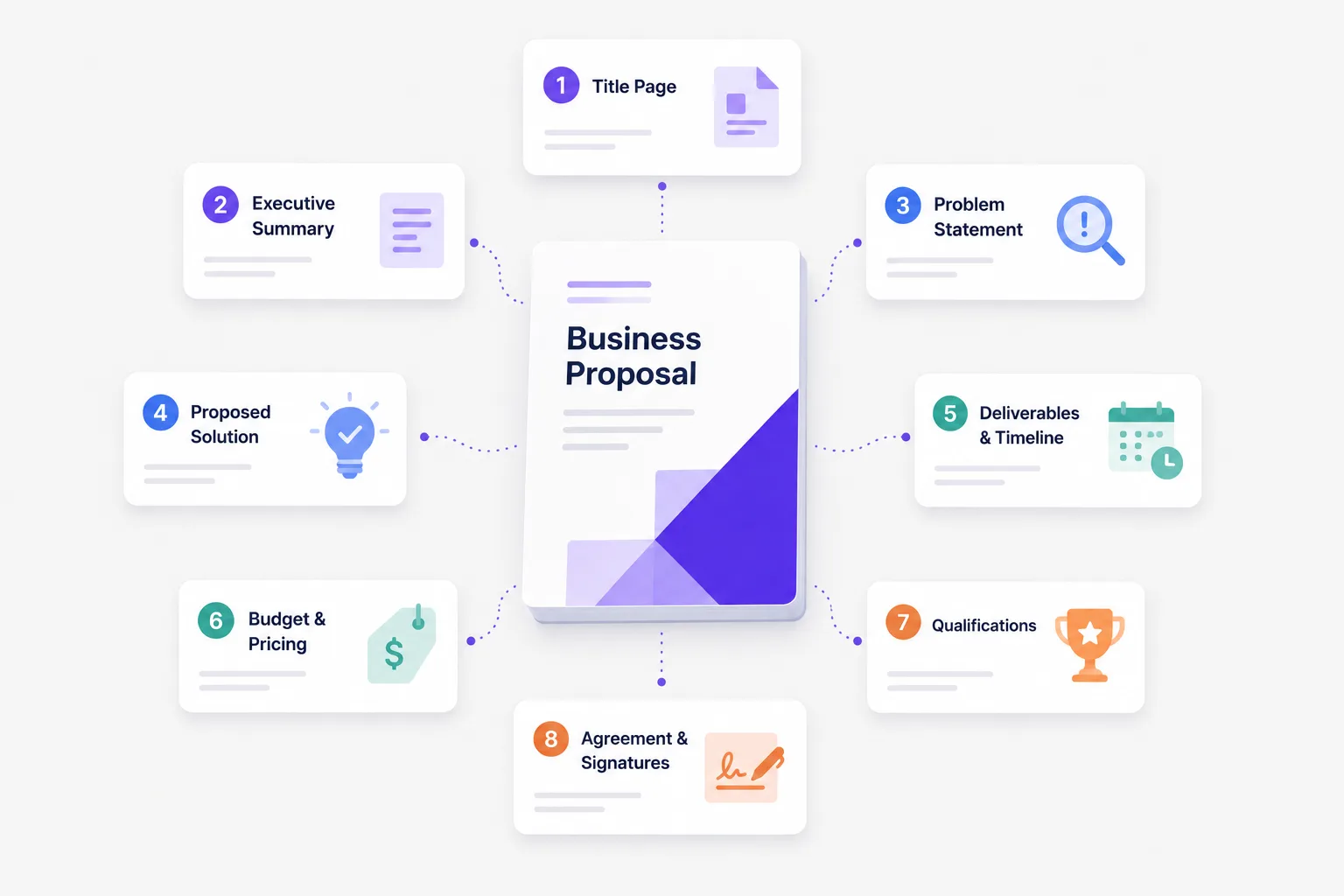
Every winning business proposal includes these 8 sections, in this order. Skipping any of them creates gaps the client will notice, and weakens your chances of signing.
1. Title page. Your company name, the client's name, the date, and contact info. Add a strong tagline that hints at value ("Next-Gen Web Experience" beats "Website Project"). Keep it clean and on-brand.
2. Executive summary. A 1-2 page overview of why you're the best fit for the job. Include your company introduction (if unsolicited), your value proposition, 1-2 examples of previous similar projects, and what the reader will find in the rest of the document. Executives may read only this section, make it count.
3. Problem statement. A clear breakdown of the client's current challenge. Use the client's own words. Reference specific data they've shared. Show that you've listened, hierarchized their issues, and understood the consequences of inaction.
4. Proposed solution. Your exact product or service, methodology, and the value it delivers. Link each deliverable to a measurable benefit specific to the client's case (hours saved per week, revenue uplift, cost reduction). Avoid generic descriptions of what you do, focus on what the client gets.
5. Deliverables and timeline. What will be completed and when. List specific deliverables with target dates. Include milestones (project phase markers) and dependencies (what could delay things). For larger projects, add a Gantt-style visualization.
6. Budget and pricing. Clear cost breakdowns, payment terms, and milestone payments. Show the total prominently. Break it down by line item. Specify payment schedule (e.g., 30 % deposit on signature, 30 % at milestone 1, 40 % on final delivery). Add taxes and any conditions (validity period, late payment fees).
7. Qualifications. Why your team is uniquely qualified for this engagement. Past case studies, client testimonials, certifications, team bios with relevant experience. For a service-led proposal, this is where you build trust.
8. Agreement and signatures. Call to action with clear legal terms and space for approval. Include next steps ("sign here, then we kick off on [date]"), validity period of the offer (15-30 days), and signature blocks. For interactive proposals, embed the e-signature directly in the document.
10 free business proposal templates by use case
Different deals need different templates. Here are 10 templates organized by use case, with notes on when to use each and where to download.
1. Standard business proposal template (multi-page)
When to use: General-purpose proposals for services or product sales above $5K. Covers the full 8-section structure.
Format: Word, PDF, Google Docs.
Best free source: Smartsheet's Business Proposal Template is excellent. Adobe also offers a free PDF version.
Customization time: 30-60 minutes per proposal once you've set up your version.
2. One-page business proposal template
When to use: Quick proposals for missions under $3K or for clients who request a short executive-style document. Compresses the 8 sections into one focused page.
Format: Word, PDF, Google Docs.
Best free source: Smartsheet 1-Page template. Microsoft Word also has built-in one-pagers.
Customization time: 15-20 minutes.
3. Startup business proposal template
When to use: Pitching a new venture to investors, partners, or angel funders. Includes business model section, revenue plan, customer segments, and growth potential.
Format: Word, PDF, Google Docs, PowerPoint.
Best free source: Smartsheet Startup Business Proposal template. SBA (Small Business Administration) also offers free templates.
Customization time: 1-2 hours (more research needed for investor proposals).
4. Marketing business proposal template
When to use: Pitching marketing strategy, channel mix, content production, or campaign work. Includes Marketing Strategy section, KPIs, and timeline.
Format: Word, PDF, Google Docs.
Best free source: Smartsheet Marketing Business Proposal template. PandaDoc has industry-specific marketing templates in their 167+ library.
Customization time: 45 minutes.
5. Consulting business proposal template
When to use: Service-led consulting engagements (strategy, operations, transformation). Includes methodology, deliverables, team bios, and engagement model.
Format: Word, PDF, Google Docs.
Best free source: Smartsheet, Proposify (free templates), or PandaDoc consulting library.
Customization time: 1-2 hours.
6. Web design business proposal template
When to use: Website design, redesign, or web app projects. Includes UX strategy, user personas, accessibility considerations, design phases.
Format: Word, PDF, Google Docs.
Best free source: Smartsheet Web Design Business Proposal. Behance and Dribbble also have inspiration.
Customization time: 1 hour.
7. Catering or hospitality business proposal letter
When to use: Event-based proposals (catering, venues, hospitality). Letter format with personalized client vision, event objectives, estimated cost.
Format: Word, PDF.
Best free source: Smartsheet Catering Business Proposal Letter template.
Customization time: 30 minutes.
8. Cleaning or services business proposal template
When to use: Project-based or recurring services (cleaning, maintenance, facilities). Includes scope, quality assurance, schedule.
Format: Word, Google Docs.
Best free source: Smartsheet Cleaning Business Proposal template.
Customization time: 30 minutes.
9. Business proposal presentation (slide deck)
When to use: Live pitches, video conference presentations, or stakeholder briefings. Slide format with problem statement slide, pricing table, next steps.
Format: PowerPoint, Google Slides, Keynote.
Best free source: Smartsheet Business Proposal Presentation. Canva also has 50+ slide deck templates. Pitch offers 10+ free decks.
Customization time: 1-2 hours.
10. Interactive web-based business proposal
When to use: Deals above $5K with a long sales cycle. Includes tracking analytics, e-signature integration, payment processing, and embeds for Calendly, Loom, Stripe.
Format: Web link (not a downloadable file).
Best free source: Propal proposal templates (free trial), Better Proposals, Qwilr, Proposify.
Customization time: 30 minutes for first proposal, 10-15 minutes for subsequent ones using your saved template.
For more on this format specifically, see our proposal templates library and our deep dive on proposal manager software.
How to write a business proposal in 7 steps
Inspired by Adobe's 7-step methodology, here's the proven process to take you from blank page to signed deal.
Step 1: Research and outline
Before writing, complete your client research. Read their RFP thoroughly if formal. Conduct a discovery call if informal. Document case studies, data, and competitive intelligence that will support your proposal. Create a 1-2 page outline using bullet points for each section. This 30-minute investment saves hours of revision later.
Step 2: Title and table of contents
Your title is your hook. "Website Project for Company XYZ" is weak. "Reimagining Digital Realms: A Strategic Web Redesign for Company XYZ" is compelling. The table of contents follows immediately, it tells decision-makers what they'll find. Most C-suite readers scan the TOC before deciding to invest deeper reading time.
Step 3: Write your executive summary
The executive summary is your 1-2 page cover letter. It introduces your company (especially for unsolicited proposals), summarizes the proposed value, includes 1-2 relevant case studies, and clearly states what the reader will find in subsequent sections. Tone: confident, optimistic, concise.
Step 4: Explain the problem statement and solution
This is the heart of your proposal. Show the client you understand their problem, use their words, cite their data. Then bridge to your solution: how you'll solve it, what specifically you'll deliver, and what value they'll receive. Demonstrate your qualifications with specific evidence (case studies, certifications, team expertise).
Step 5: List deliverables, milestones, and budgets
Translate your solution into specific deliverables with target dates. Define milestones as project phase markers. Break down your budget by line item. Include payment terms (30/30/40 is common, but adjust to your context). Use a table for clarity.
Step 6: Craft the conclusion and appendix
Conclude by summarizing main points, reiterating your strengths, and creating a clear call to action with urgency ("Validity period: 15 days from this proposal's date"). The appendix can include reference materials, definitions, methodology details, or supplementary case studies.
Step 7: Edit and professionally polish
A winning business proposal is polished, eye-catching headings, zero typos, clear time frames, detailed scope of work, and a payment schedule the client can immediately understand. Before sending, redact sensitive information from previous client work, verify all numbers, and run a final spell-check. For deals above $20K, consider a fresh-eyes review from a colleague.
The three C's of proposal writing
The three C's of proposal writing: Clarity, Conciseness, Compellingness, are the test every winning proposal passes. AI tools amplify or undermine each depending on how you use them.
Clarity is about structure: visible headers, scannable sections, logical flow from problem to solution to pricing. Every page should answer "what is this section about" in three seconds. AI excels at structure, use it for the scaffolding.
Conciseness is about word count and signal-to-noise. The best proposals say more with less. According to San Jose State University's guide, the ideal length is 5-15 pages for most service proposals, anything longer dilutes attention. AI tends to over-write; edit aggressively after generation.
Compellingness is about persuasion: case studies that mirror the client's situation, language that echoes their own words, a closing argument that addresses their specific risk. This is where AI consistently underperforms, and where human writing still wins deals.
Free vs paid business proposal templates: what's actually different?
The "free" promise is everywhere. Here's the honest comparison.
| Feature | Free templates | Paid platforms |
|---|---|---|
| Template variety | 10-50 free templates | 100-167+ industry-specific |
| Brand kit | Basic | Full auto-apply |
| E-signature integration | Need separate tool | Built-in |
| Tracking analytics | No | Real-time |
| Payment processing | No | Stripe / PayPal |
| Team collaboration | Solo only | Multi-user |
| Output format | PDF, Word, Google Docs | Web interactive + PDF |
| Cost | Free | $15-50/month |
Free templates work for one-off proposals or solo freelancers under $2K deals. For agencies, consulting firms, and SaaS teams sending 5+ proposals per month, even the cheapest paid plan pays back fast in saved time + higher close rates. For a deeper comparison, see our guide on proposal template software.
Can ChatGPT write a business proposal?
Yes, but with caveats. ChatGPT can generate a first-draft business proposal in 60-90 seconds from a short prompt. That covers the writing side. What ChatGPT can't do: produce a polished final document with your brand voice, accurate pricing, e-signature integration, tracking analytics, or proposal-specific templates.
The pattern that works in 2026: use ChatGPT for the executive summary, problem statement, and solution sections (the writing-heavy parts), then drop that content into a dedicated proposal template (visual + workflow features). The combination of AI drafting + human review + dedicated proposal platform reduces total creation time substantially vs writing from scratch.
For a deeper dive on AI specifically, see our AI proposal generators guide.
Interactive vs static business proposals: the 2026 shift
The biggest change in this category over the last 18 months: web-based interactive proposals replacing PDF attachments for any deal above $5K.
Static proposals (PDF, Word) give you zero feedback between sending and the client's reply. Interactive proposals (web-based) let you track when the proposal is opened, which sections the client spends most time on, whether they shared it internally. Per-section engagement analytics let you follow up at the right time with the right argument.
Beyond tracking, interactive proposals support embeds that compress the sales cycle: Calendly booker for the kickoff call directly inside the proposal, Loom video introduction from you, Stripe payment button for the deposit, e-signature in the same document. Each embed removes a friction step between "client wants to sign" and "deal is closed."
Agencies that have switched typically report meaningful improvements in conversion. For agencies, freelancers, and consulting firms sending B2B proposals above $5K, the format shift pays back fast.
To see the interactive format in action, browse our proposal templates library, free with no credit card required.
Conclusion
The right business proposal template depends on your deal size, format need, and workflow stage. Free Word/PDF templates from Smartsheet, Adobe, or Microsoft Word work for solo freelancers and one-off proposals. Paid platforms like Propal, PandaDoc, or Proposify pay back fast for agencies sending 5+ proposals per month with their template variety, tracking, e-signature, and payment features built in.
Whichever template you choose, follow the 8-section structure and the 7-step writing process, those fundamentals stay constant. The 2026 shift toward interactive proposals (web format with tracking + e-signature + payment + embeds) is the biggest format change in years. Agencies that switched typically report measurably higher close rates.
To see interactive templates in action, browse our proposal templates library, free with no credit card required.
.webp)