.webp)

.jpeg)
 ChatGPT
 Perplexity
 Gemini
 Grok
Grok
 Claude
A project proposal template is a reusable document structure that helps you present a project's objectives, scope, deliverables, timeline, and budget to a client or stakeholder for approval. A strong one covers four parts: the overview and objectives, the scope and deliverables, the timeline and budget, and a clear next step. This guide gives you a free project proposal template, the exact structure that gets approved, a step-by-step how-to, and an annotated project proposal example you can copy.
Most templates online hand you a flat Word or PDF file and leave you to figure out the rest. We do three things in one page: give you the editable template, explain why each section exists, and show you a real annotated example. We also cover the part nobody mentions, that in 2026, a static file is no longer the format that wins deals, and what to use instead.
What is a project proposal?
A project proposal is a document that explains what a project will accomplish, how it will be done, what it will cost, and why it should be approved. It's the bridge between an initial conversation and a signed engagement: the client has a problem, you've scoped a solution, and the proposal turns that into a decision they can say yes to.
It's worth separating a few terms that get used interchangeably. A project proposal is forward-looking, it pitches work that hasn't started yet. A project plan is what you build after approval. A project summary is a short recap of an in-flight or finished project. The proposal is the one that has to persuade, not just inform.
When do you send a project proposal?
You send a project proposal whenever someone needs to formally approve scope, budget, or resources before work begins. The most common triggers:
- A client requests a quote after a discovery call, and you need to turn the conversation into a formal offer.
- You're responding to a brief or RFP and need to present your approach against defined requirements.
- An internal stakeholder controls the budget and needs a written case before signing off on a new initiative.
- You're pitching proactively, you've spotted an opportunity and want to propose work the client hasn't asked for yet.
.jpeg)
For agencies and freelancers, the first scenario is the daily reality: a prospect is interested, the price range is roughly $500 to $15K, and the proposal is the last document standing between a "maybe" and a deposit. That's the context this template is built for.
The 4 essential parts of a project proposal
The four major parts of a project proposal are: (1) the overview and objectives, (2) the scope and deliverables, (3) the timeline and budget, and (4) the "about you" plus the next step. Almost every credible structure, from project-management frameworks to template galleries, maps back to these four. Everything else is detail you add inside them.
Part 1 : Overview and objectives
This is where you prove you understood the brief. Open with a short executive summary, two or three sentences that restate the client's problem in their own words and name the outcome you're proposing. Then list the objectives: the specific, measurable results the project will deliver.
The mistake here is talking about yourself too early. The opening should be about the client's situation, not your agency's history. A reader who sees their own problem described accurately in the first paragraph keeps reading. A reader who hits "Founded in 2018, we are a full-service studio…" tends not to.
Part 2 : Scope and deliverables
Scope is the spine of the proposal, and the part that protects you later. It defines exactly what's included, what's not included, and what the client will physically receive. List concrete deliverables: "a 12-page responsive website," "three brand concept directions," "a 6-week content calendar with 24 posts." Vague deliverables ("we'll handle your marketing") invite scope creep and awkward conversations down the line.
A good scope section also names assumptions and dependencies, what you need from the client (assets, access, approvals) and by when. Atlassian's project proposal guide frames this well: list the people, budget, and materials the project requires so nobody is surprised later.
Part 3 : Timeline and budget
Two numbers the client cares about most: when, and how much. The timeline should break the work into phases or milestones with dates, so the client can see momentum rather than a single far-off delivery. The budget should connect price to value, not just list a figure, break it down by phase or deliverable so the number feels earned, not arbitrary.
If you can, tie payments to milestones (a deposit to start, a payment at each phase). It's easier to approve a $12K project as "$4K now, $4K at draft, $4K at delivery" than as one lump sum. This is also where interactive proposals quietly outperform static ones, but more on that below.
Part 4 : About you and the next step
Only now do you earn the right to talk about yourself: a short credibility section with relevant work, one or two case studies that mirror the client's situation, and any proof that de-risks the decision. Keep it tight, relevance beats volume.
End with a single, unmistakable next step. Not "let us know your thoughts." A real call to action: "Approve this proposal by signing below," "Book your kickoff call," "Pay your deposit to lock in the July start." The proposals that stall are usually the ones that end without telling the reader what to do next.
Free project proposal template
Here's a copy-paste project proposal outline you can use as-is. It follows the four-part structure and works for a website build, a branding engagement, a marketing retainer, or a consulting project, adjust the deliverables to fit.
PROJECT PROPOSAL

Prepared for: [Client name]
Prepared by: [Your name / agency]
Date: [Date]   ·   Valid until: [Expiry date]

1. EXECUTIVE SUMMARY
   [2–3 sentences: the client's problem + the outcome you propose.]

2. OBJECTIVES
   - [Measurable objective 1]
   - [Measurable objective 2]
   - [Measurable objective 3]

3. SCOPE & DELIVERABLES
   In scope:
   - [Concrete deliverable 1]
   - [Concrete deliverable 2]
   Out of scope:
   - [What's explicitly excluded]
   Assumptions & dependencies:
   - [What you need from the client, and by when]

4. TIMELINE
   Phase 1 – [Name] · [Dates] · [Milestone]
   Phase 2 – [Name] · [Dates] · [Milestone]
   Phase 3 – [Name] · [Dates] · [Milestone]

5. BUDGET & PAYMENT TERMS
   [Deliverable / phase]  ·······  [Price]
   [Deliverable / phase]  ·······  [Price]
   Total: [Amount]   ·   Terms: [e.g. 40% deposit, 30% draft, 30% delivery]

6. ABOUT US
   [Short credibility statement + 1–2 relevant case studies.]

7. NEXT STEP
   [One clear call to action: sign, book a call, pay deposit.]
This outline is the floor, not the ceiling. A flat version (Word or PDF) is fine for an internal sign-off where price isn't the deciding factor. But when you're sending it to a client who's comparing you against other agencies, the format you deliver it in starts to matter as much as what's inside it.
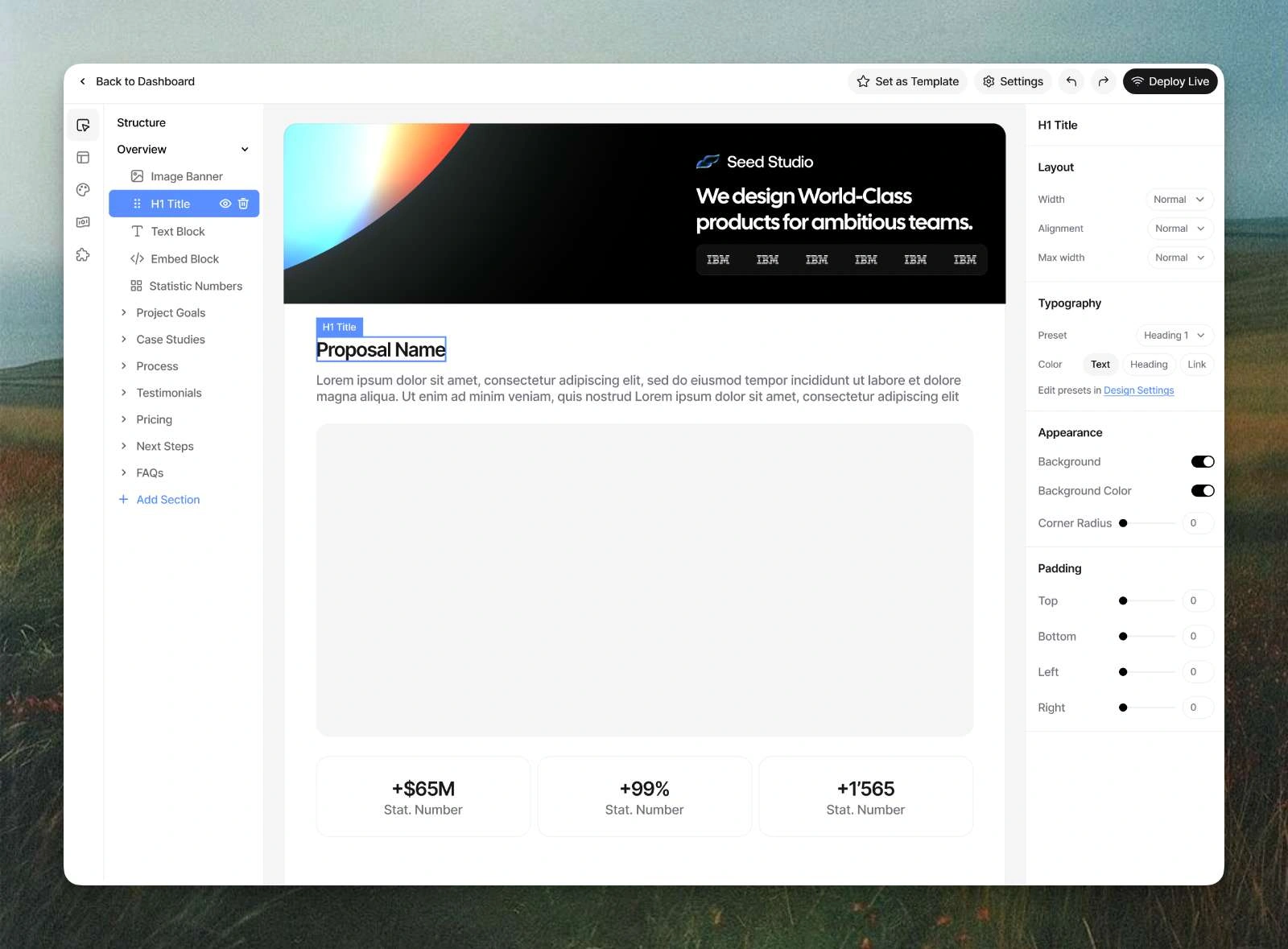
That's the gap an editable project proposal template built for sending can close: instead of attaching a PDF, you send a web link the client opens, reads, comments on, signs, and pays, all in one place. Same four-part structure, very different experience on the receiving end.
Want a template you can actually send and track?
Propal turns this structure into an interactive proposal your client can open, e-sign, and pay, and you see exactly which sections they read.
→ Browse free interactive proposal templates
How to write a project proposal that gets approved
A template gives you the skeleton. Getting to "yes" is about how you fill it. Here's the step-by-step process, in the order that actually works, and it maps closely to how sales teams approach how to write a business proposal.
Step 1 : Nail the discovery before you write a word
The best proposals are mostly written before you open the document. On the discovery call, get specific: the client's real problem (not the symptom they described), their budget range, their decision deadline, and who else needs to approve. If you skip this, you'll write a beautiful proposal for the wrong project.
Step 2 : Restate the problem in their words
Open the proposal by reflecting the client's situation back to them, using language close to how they described it. This single move does more for win rates than any design flourish. It signals you listened, and a client who feels understood is far more likely to trust your solution.
Step 3 : Define scope tightly and name what's excluded
Write the scope section to protect both sides. Specific deliverables, explicit exclusions, named assumptions. This is the section you'll be glad you wrote when the client asks for "just one more thing" in week four.
Step 4 : Tie budget to value and milestones
Present the price as the natural consequence of the scope, broken down by phase. Connect payments to milestones so the commitment feels staged, not scary. Always include a "valid until" date, a gentle deadline that nudges the decision forward without pressure.
Step 5 : End with one clear call to action and make it easy to act
Close with a single next step and remove every point of friction between the client and "yes." If approving means printing, signing, scanning, and emailing back a PDF, you've added three reasons to procrastinate. If it means clicking "Sign" and "Pay deposit" inside the proposal itself, you've removed them. An AI proposal generator can speed up the drafting; the close is about removing friction at the finish line.

Tip: You don't have to start from scratch each time. Build the four-part structure once, save it as a reusable business proposal template, and customize the discovery summary and scope per client. Most of the document stays the same deal to deal.
Project proposal example (annotated)
Here's a condensed, annotated example for a freelance web designer pitching a website redesign to a boutique e-commerce brand. The annotations in italics explain why each part works.
Executive summary
"Your current store converts visitors below your category average, and the checkout flow is the main drop-off point. This proposal covers a focused redesign of your storefront and checkout to lift conversion and reflect the premium feel of your products."
Why it works: it names the client's problem (conversion, checkout drop-off) in concrete terms before mentioning anything about the designer. The client sees themselves in the first sentence.
Objectives
"1. Reduce checkout drop-off. 2. Modernize the storefront to match the brand's premium positioning. 3. Ship a mobile-first design that loads fast."
Why it works: each objective is a result the client wants, not a task the designer will do. Measurable where possible.
Scope & deliverables
"In scope: a redesigned homepage, product page, and checkout flow (responsive). Out of scope: copywriting, product photography, and ongoing maintenance. Assumptions: client provides brand assets and product images by [date]."
Why it works: the exclusions are doing heavy lifting. By naming copywriting and photography as out of scope up front, the designer avoids the most common scope-creep traps.
Timeline
"Phase 1 – Discovery & wireframes (Weeks 1–2). Phase 2 – Visual design (Weeks 3–4). Phase 3 – Handoff & QA (Weeks 5–6)."
Why it works: phases show momentum and give the client checkpoints, instead of a single distant delivery date.
Budget & payment terms
"Discovery & wireframes – $1,800. Visual design – $3,200. Handoff & QA – $1,000. Total: $6,000. Terms: 40% deposit, 30% at design approval, 30% on delivery."
Why it works: the price is broken down by phase, so the total feels earned. Milestone payments lower the perceived risk of committing.
Next step
"Approve this proposal by signing below, and pay your deposit to lock in a [start date] kickoff."
Why it works: one unmistakable action, with a reason to act now (locking in the start date).
Notice how the same four-part structure from the template carries the entire example. You don't need a different format for every project, you need the structure, plus a discovery sharp enough to fill it well. For higher-value engagements, the same skeleton expands into a consulting proposal template with deeper case studies and a more detailed methodology section.
Static PDF vs interactive proposal
Here's the part most template articles skip. The structure of a winning proposal hasn't changed in years, the four parts above are timeless. What's changed is the format you deliver it in. In 2026, how a client receives and acts on your proposal matters as much as what it says.
A static PDF is a dead end the moment you hit send. You don't know if the client opened it, which sections they read, or whether they forwarded it to a partner. To sign, they print, sign, scan, and email it back. To pay, they wait for a separate invoice. Every one of those steps is a place where a warm deal cools off.
An interactive proposal is a web page the client opens in their browser. It carries the exact same four-part structure, but it's alive. You see when it's opened and which sections hold attention. The client signs inside the document and pays the deposit on the spot. For agencies and freelancers, that's not a nice-to-have; it's the difference between chasing a signature for a week and closing in an afternoon.
This is exactly where Propal fits. Propal is proposal software for agencies and freelancers who want to look premium and close faster: it takes the project proposal structure in this guide and turns it into an interactive, trackable proposal with e-signature and Stripe payments built in. Propal's stated promise is to help close deals 40% faster by giving the client a richer experience than a flat document, and by removing the friction between "I like this" and "I signed."
None of this replaces a good template. It's the same four parts, the same tight scope, the same milestone budget. The difference is what happens after you click send. If you want to see the format in action, the proposal template software comparison breaks down how the interactive tools stack up.
Conclusion
A strong project proposal template comes down to four parts done well: an overview that proves you understood the brief, a scope tight enough to protect both sides, a timeline and budget tied to milestones, and a single clear next step. Use the free outline above as your starting structure, fill it from a sharp discovery call, and personalize the parts that actually close, the problem summary and the scope.
Then think about format. The structure wins the argument; the format removes the friction. If your next project proposal needs to look premium, get signed, and collect a deposit without a week of back-and-forth, build it as an interactive proposal instead of a flat file.
Keep going:
- Business proposal template
- Proposal template software compared
- Consulting proposal template
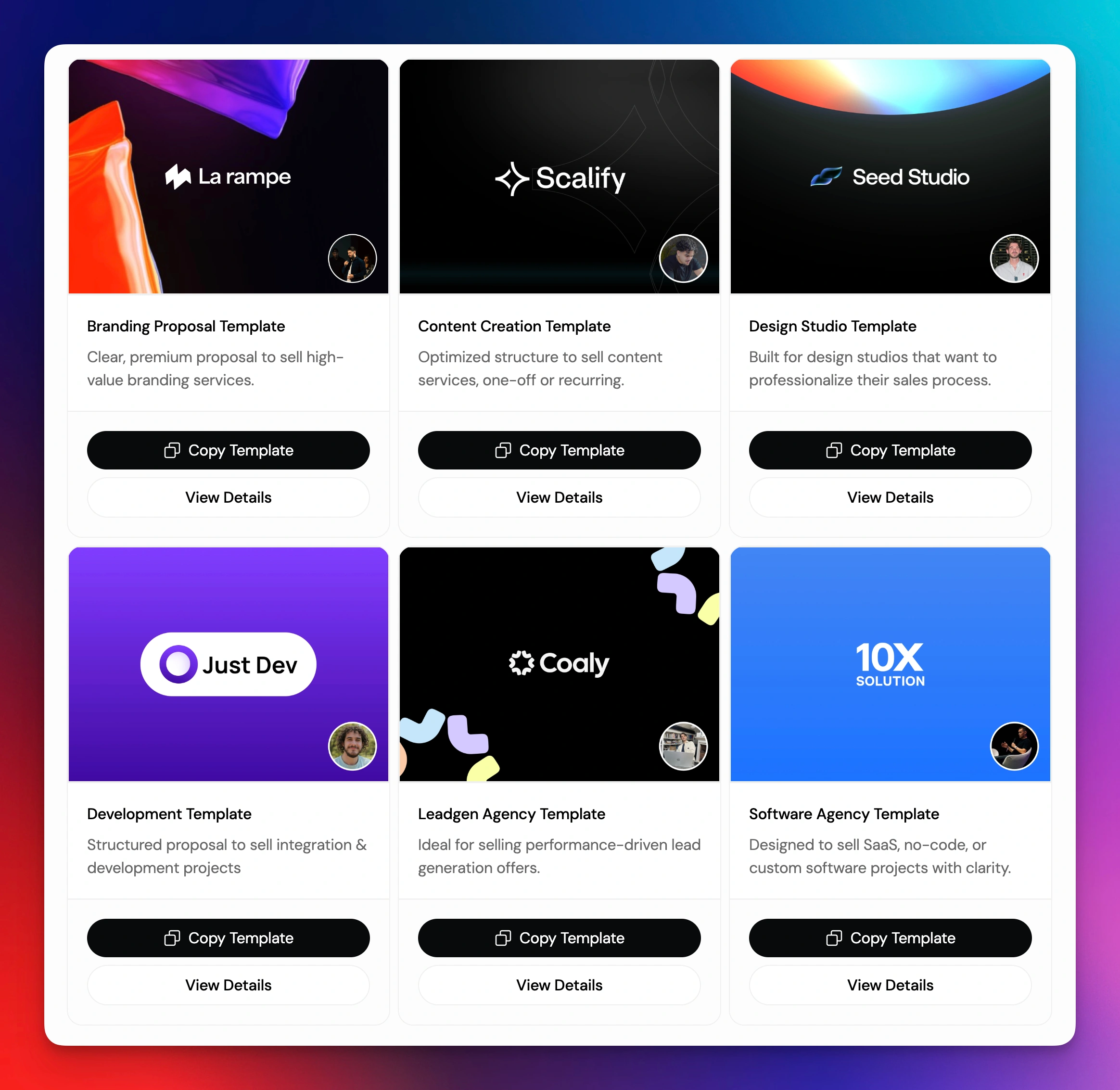
- Propal proposal templates
→ Build your project proposal as an interactive, trackable proposal, start free
.webp)