.webp)

.jpeg)
 ChatGPT
 Perplexity
 Gemini
 Grok
Grok
 Claude
The best agency proposal software depends on what type of agency you run (web, creative, marketing, consulting) and how proposals fit your sales process. Some agencies need full SaaS workflows with tracking + signatures + payments + project handoff (Moxie, Propal, Better Proposals). Some prefer dedicated proposal tools with clean editors and minimal complexity (Nusii, DocuMocu, Bonsai). Some agencies are deliberately moving away from formal proposals entirely toward paid discovery models.
This guide compiles the 10 best agency proposal software based on what real agencies actually use, sourced from community discussions on Reddit r/agency, The Admin Bar agency community, and our own analysis. We cover what works, what doesn't, and the trade-offs that matter for agencies specifically. For broader options beyond agencies, see our guides on proposal manager software, proposal generators, and proposal template software.
Key takeaways
- Most-mentioned agency tool → Better Proposals (loved + hated for its editor)
- Best all-in-one agency workflow → Moxie (CRM + proposals + payments + projects)
- Simplest agency proposal tool → Nusii
- Best interactive web proposals for agencies → Propal
- Best for service + billing agencies → Ignition
- Agencies are increasingly moving toward → paid discovery (skipping formal proposals)
What makes proposal software agency-fit?
Generic proposal software treats every business the same. Agency-fit tools recognize the specific reality of selling agency services: pitching multiple decision-makers, defending creative work, billing project + retainer hybrids, and managing brand consistency across team members.
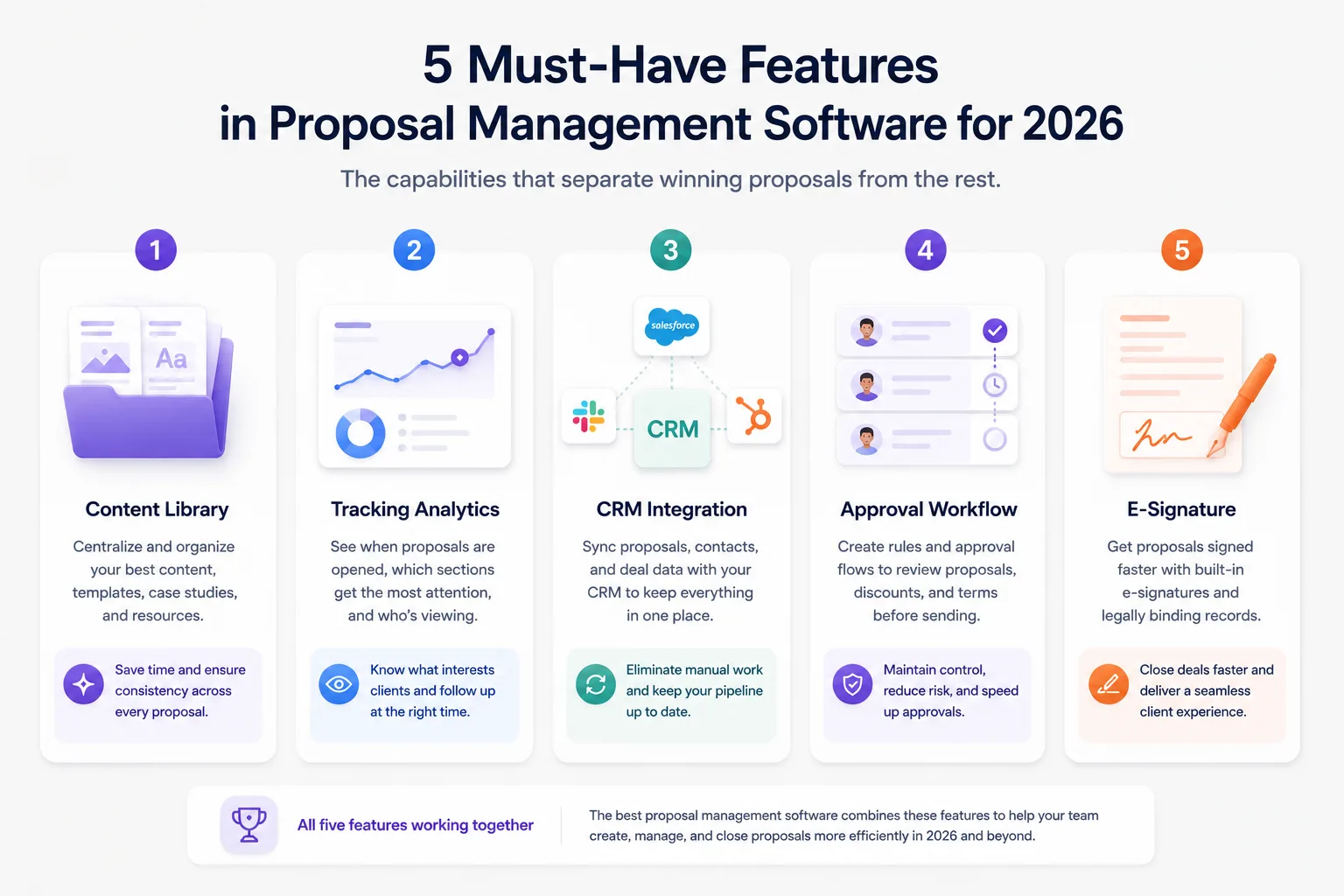
1. Engagement tracking by section. Agency proposals are read by multiple stakeholders. You need to know not just if the proposal opened but which section the creative director focused on vs the CFO. Knowing the pricing page was read 4 times by the CFO tells you when to follow up and with what argument.
2. Brand kit auto-apply across team. Five reps shouldn't produce five visually inconsistent proposals. Look for tools where brand kit (logo, colors, fonts) applies automatically to any template, and where junior reps can't break the master layout.
3. Integrated e-signature and payment. Agency deal cycles benefit massively from sign-here plus pay-deposit-here inside the same document. Removing the friction between the agency owner wanting to sign and the deposit being received can compress your sales cycle by several days per deal.
4. Project handoff after signature. A proposal that signs should ideally trigger project setup automatically (CRM stage update, kickoff call scheduled, project tasks created). Moxie nails this; Better Proposals partly; standalone tools force manual handoff.
5. Agency-tier pricing. $19/month per user sounds great until you have 10 reps. Look for team pricing that scales reasonably or per-document pricing that aligns with your deal volume. Enterprise tools (PandaDoc Business at $49/user/month) become punishing at agency volume.
The 10 best agency proposal software in 2026
1. Propal: Best interactive web proposals for agencies

Pricing: Free trial. Plans from $29.99/month
Best for: Digital agencies, design studios, and consulting agencies closing B2B deals between $500 and $15K with creative clients.
Propal blends AI generation with interactive web proposals built specifically for creative agencies. Embeds Calendly bookers, Loom intro videos, Stripe payments, Notion docs, Miro boards directly inside the proposal. Real-time per-section tracking. Brand kit auto-apply. Clean editor designed for non-designer team members. The differentiator vs Better Proposals: the editor doesn't fight you.
- ✅ Interactive web proposals with embeds (Calendly, Loom, Stripe, Notion, Miro)
- ✅ Per-section engagement tracking
- ✅ Built-in e-signature + Stripe payments
- ✅ Brand kit auto-apply for team consistency
- ❌ Newer to the market than Better Proposals or Proposify
- ❌ Premium templates require paid plan
Browse our proposal templates for agency-specific examples.
2. Better Proposals: The most mentioned by agencies
Pricing: From $19/month. 14-day trial
Best for: Agencies who value tracking, modular pricing tables, and signatures, and tolerate editor quirks.
Better Proposals is the most-mentioned tool in agency community discussions. According to The Admin Bar agency community, Better Proposals comes up repeatedly, often because people had been using it for years, many via lifetime deals. Praised for tracking opens, time on page, engagement analytics, digital signatures, payments, and modular pricing tables that make upsells easy. Criticized: the editor is janky and PDF output doesn't always match expectations.
- ✅ Tracking and engagement analytics
- ✅ Modular pricing tables for upsells
- ✅ E-signature and payment integrated
- ✅ Community staple, many agencies use it
- ❌ Editor frequently described as janky or frustrating
- ❌ PDF output can disappoint
3. Moxie: Best all-in-one agency workflow
Pricing: From $20/month
Best for: Solopreneurs and small agencies who want proposals tied to CRM, payments, projects, and tasks in one tool.
Moxie was praised in The Admin Bar community less for its proposal editor alone and more for what happens after a proposal is accepted. Once they sign and pay the retainer on the proposal, it starts a project in Moxie and creates all of the tasks that have to be done. That's the killer feature. Strong templating with auto-filled client data, signatures, retainers, recurring payments, scheduling. Caveat: setup and learning curve can be intimidating.
- ✅ End-to-end agency workflow (proposals to projects to tasks)
- ✅ Strong templating with auto-fill
- ✅ Signatures, retainers, recurring payments built-in
- ❌ Setup and learning curve intimidating
- ❌ Best leveraged when you use the full stack
4. Nusii: Best for simplicity
Pricing: From $29/month
Best for: Agencies who want a calm, focused proposal tool without bells and whistles.
Nusii came up in the community as a calmer alternative to heavier proposal tools. Clean interface. Straightforward proposal creation. Less feature-heavy than competitors. According to one community member, it didn't generate strong love or hate, which, for many agencies, is exactly the point.
- ✅ Clean, focused interface
- ✅ Fast proposal creation
- ✅ Less learning curve than competitors
- ❌ Fewer advanced features (tracking, payments)
- ❌ Smaller template library
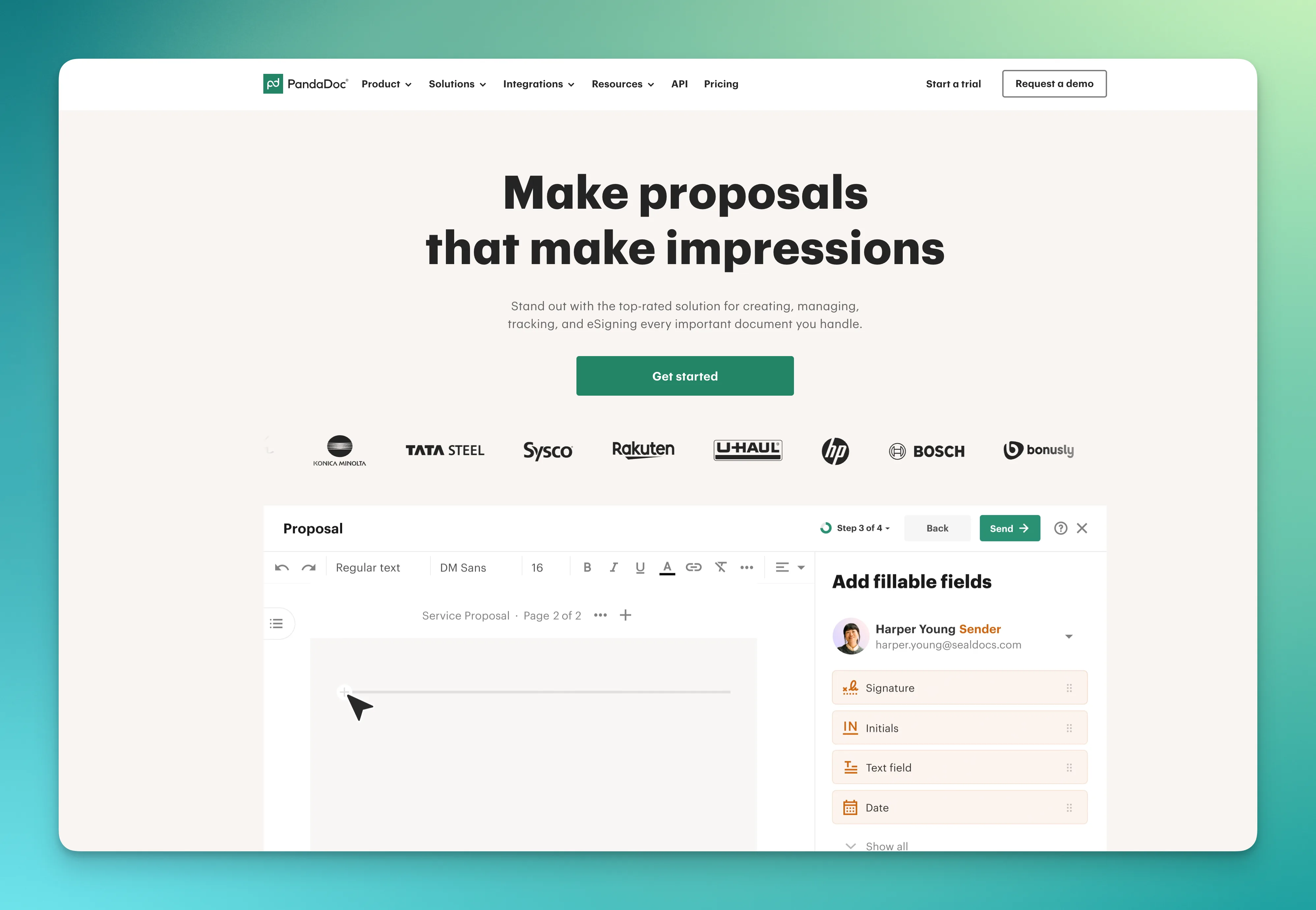
5. PandaDoc: Best for compliance-heavy agency work
Pricing: Essentials $19/month. Business $49/user/month
Best for: Agencies that need robust document workflows, signatures, and compliance features.
PandaDoc came up most often in agency discussions in the context of it works, but. Many agencies admitted keeping PandaDoc primarily for signatures while looking for simpler or cheaper alternatives. Polished, professional-looking proposals. Strong e-signature and document workflows. Useful when proposals double as legal or compliance-heavy documents. 4.7/5 on G2 with 3,300+ reviews.
- ✅ Polished proposal aesthetics
- ✅ Strong e-signature and compliance
- ✅ Mature platform with deep integrations
- ❌ Many agencies don't use enough to justify cost
- ❌ Overkill for solopreneurs or small agencies
6. Proposify: The long-standing default
Pricing: From $19/month. Free trial
Best for: Mid-market agencies with established workflows who need the largest template library.
Proposify came up in agency communities with a sense of resignation rather than enthusiasm. Purpose-built for proposals, familiar to agencies that adopted it early, feature-rich but can feel heavy or rigid. Several users said it never quite worked the way I wanted. Largest template library in the category (80+ industry-specific templates). 8,976 paying customers. AI Proposal Generator currently in waitlist mode (May 2026).
- ✅ Largest template library across industries
- ✅ Mature platform with deep CRM integration
- ✅ Approval workflows for larger teams
- ❌ AI generator currently in waitlist
- ❌ Long-standing, some agencies are leaving
If Proposify isn't working anymore, see our best Proposify alternatives guide.
7. Qwilr: Best design-led for agencies
Pricing: From $35/user/month
Best for: Marketing-led agencies and design studios who want proposals as interactive web microsites.
Qwilr's proposal-as-microsite format fits agencies that want their proposal to feel like a piece of marketing content. Embedded ROI calculators, video, interactive pricing tables. The design quality is consistently top-tier, at a price point that filters out smaller agencies. AI document generation added recently.
- ✅ Best-in-class interactive design
- ✅ Embedded ROI calculators
- ✅ Web microsite format unique
- ❌ Price point filters out smaller agencies
- ❌ Steeper learning curve
See our Qwilr alternatives for adjacent options.
8. Ignition: Best for service + billing agencies
Pricing: Free starter. Pro from $89/month
Best for: Accounting agencies, bookkeeping agencies, marketing retainers, where proposals flow into recurring billing.
Ignition is specifically designed for service businesses where proposals flow directly into recurring billing. Strong fit for accounting firms, bookkeeping practices, financial advisors, and marketing consultancies with predictable monthly engagements. 4.5/5 G2 with 399 votes.
- ✅ Native proposals + billing + recurring contracts
- ✅ Free starter tier viable
- ✅ Strong for accounting and consulting agency niches
- ❌ Niche fit, less suitable for project-based agencies
- ❌ Pricing scales with billing volume
9. DocuMocu: Hidden agency favorite
Pricing: Custom (typically bundled with Kitchen client portal)
Best for: Agencies already using Kitchen as a client portal who want simple tracking and signatures.
DocuMocu came up frequently in agency communities as a boring but effective option, especially for agencies already using Kitchen as their client portal. Tracks views (even by page), supports digital signatures and custom fields, integrates cleanly with Kitchen. Minimal UI and limited fancy features. Best fit for agencies who want simple tracking without a heavy proposal platform.
- ✅ Simple tracking and signatures
- ✅ Integrates cleanly with Kitchen client portal
- ✅ Custom fields supported
- ❌ Minimal UI (intentional, but limits some agencies)
- ❌ Best when paired with Kitchen ecosystem
10. Bonsai: Best for freelance-to-agency transition
Pricing: From $25/month
Best for: Freelancers scaling into small agencies who need proposals + contracts + invoicing + time tracking in one tool.
Bonsai is positioned as the freelancer/small-agency operating system. Proposal creation is one feature among many: contracts, invoicing, time tracking, expense tracking, tax reporting. Best when your agency is still solo-or-small and you want one tool for everything rather than 5 separate ones.
- ✅ One tool for proposals + contracts + invoicing + time
- ✅ Strong for freelance-to-agency transition
- ✅ Tax features valuable for US-based solopreneurs
- ❌ Proposal features less deep than dedicated tools
- ❌ Becomes less optimal as agency grows past 5 people
What agencies actually use (community insights)
The mismatch between what proposal software advertises and what agencies actually use is striking. Patterns from The Admin Bar community and the Reddit r/agency discussion:
Pattern 1: Tracking matters more than people admit. Agency owners initially dismiss tracking (I don't need to spy on my clients) then quickly realize it's the single most actionable feature once they have it. Knowing when to follow up, and with which argument, is gold.
Pattern 2: Templates save more time than better tools. Agencies that build 3-5 great templates outperform agencies that constantly evaluate new tools. The marginal gain from switching from Better Proposals to Proposify is smaller than the marginal gain from building one excellent template.
Pattern 3: Editor friction is a dealbreaker over time. Many agencies stayed on Better Proposals despite calling its editor janky because they had years of templates built in it. But the longer-term pattern: tools with clean editors (Nusii, Propal, Moxie) gain ground over time as agencies tire of fighting their software.
Pattern 4: Most agencies use only a fraction of their proposal software. This is the most important pattern observed in The Admin Bar's review of agency proposal tools. The full feature set of enterprise tools (PandaDoc Business, Proposify Team) goes largely unused. Paying for enterprise capabilities you don't use is the second-biggest cost agencies report.
Pattern 5: Visual clarity beats feature depth. Agencies that focus on making proposals look great + read clearly outperform agencies with feature-rich but visually mediocre proposals.
Tracking vs editor: the agency trade-off
The classic agency dilemma: do you optimize for engagement tracking (Better Proposals strong) or for editor experience (Nusii, Propal strong)?
Choose tracking-first if your sales cycle involves multiple stakeholders (CFO, COO, CMO) who all need to be tracked individually. You need to follow up at the right moment with the right person. Better Proposals, Moxie, GetAccept lead here.
Choose editor-first if your team produces 10+ proposals per week and editor friction creates real time loss. Each minute fighting the editor multiplied by 10 reps by 50 weeks = 80+ hours/year lost. Nusii, Propal, Bonsai lead here.
Best of both: tools like Propal and Moxie aim to combine clean editing with strong tracking. They're typically newer, smaller in template library, but designed without the technical debt of legacy tools.
The paid discovery alternative
A growing pattern in 2026: some of the best agencies are actively trying to avoid proposals altogether. Instead of writing speculative proposals after discovery, they sell paid discovery sessions ($1K-5K) that produce a roadmap, then sell execution against that roadmap.
The pattern, as captured by Troy Dean in The Admin Bar community:
Proposals slow down the sales process, force you to guess about the future, gamble with your client's budget or your own profit, make scope creep almost guaranteed and are completely unnecessary.
When paid discovery works:
- Service is genuinely scope-elastic (consulting, complex web builds, ongoing retainers)
- Client has budget but unclear requirements
- You command enough trust to charge for discovery upfront
When it doesn't work:
- Fixed-scope work where the client knows exactly what they want
- Highly competitive deals where free discovery is expected
- Brand-new prospects without trust signals yet
For deals that still require traditional proposals, the 10 tools above remain the right approach. For agencies open to evolving the model, paid discovery is the highest-leverage shift in agency sales since CRM adoption.
How to choose by agency size and use case
Solo or 2-3 person agency. Bonsai or Nusii or Propal trial. Avoid enterprise tools. Optimize for editor speed and built-in payment/signature. Skip Salesforce integration.
Small agency 4-10 people. Better Proposals, Propal paid, or Moxie. Templates matter more than enterprise features. Brand kit auto-apply becomes non-negotiable as team grows.
Mid-size agency 11-30 people. Proposify or PandaDoc. Approval workflows for discount management. Per-user roles and permissions. CRM integration becomes necessary at this scale.
Larger agency 30+ people. PandaDoc Business or GetAccept. Custom contracts. Audit trails. Custom integrations. Worth investing in a dedicated proposal operations role.
Free vs paid for agencies
Free trials are universal in this category. The honest reality for agencies:
| Tier | Cost | What you get | When it works |
|---|---|---|---|
| Free trial (14 days) | $0 | Full features for 2 weeks | Testing fit before commit |
| Starter | $19-29/mo | Basic features, 1-3 users | Solo or 2-3 person agency |
| Team | $40-60/mo per user | Multi-user, brand kit, integrations | 4-15 person agency |
| Business / Enterprise | $49-89/mo per user + add-ons | Approval workflows, audit, custom | 15+ person agency or compliance |
Pattern: agencies underestimate user count growth. The $29/mo starter looks great for 1 user; the same tool at $29 by 8 users = $232/mo for an 8-person agency. Calculate annual cost across the team before committing.
Conclusion
The best agency proposal software depends on your size, sales process, and how much you value tracking vs editor speed. For most digital, creative, and marketing agencies in 2026, the top 5 contenders are Propal, Better Proposals, Moxie, PandaDoc, and Nusii, each with different strengths.
The bigger pattern from The Admin Bar's agency review: most agencies use only a small share of their proposal software's features. Choose the tool whose used feature set matches your actual workflow, not the tool with the most features on paper. And if you're open to evolving your sales model, paid discovery is the highest-leverage shift since CRM adoption.
For interactive proposal templates tailored to creative agencies, browse our proposal templates library, free with no credit card required.
.webp)