.webp)

.jpg)
 ChatGPT
 Perplexity
 Gemini
 Grok
Grok
 Claude
You built a great proposal. You spent time on the research, nailed the pricing, and made it look professional. Now comes the part that many freelancers and agencies overlook: the delivery. How you send your proposal matters as much as what is inside it. The wrong subject line, the wrong format, or the wrong timing can turn a winning proposal into one that never gets opened.
This guide covers everything about how to send a proposal to a client effectively: the email that introduces your proposal, the best format to use, the timing that maximizes opens, and the follow-up strategy that turns silence into signatures.
Before You Hit Send: The Pre-Send Checklist
Before thinking about the email itself, make sure your proposal is ready to go. A poorly prepared proposal undermines even the best delivery.
Verify client details
Double-check the client's name (spelled correctly), company name, project title, and any specific references from your conversations. A proposal addressed to the wrong person or with a misspelled name signals carelessness. When learning how to send a proposal to a client, this basic step prevents embarrassing mistakes.
Proofread everything
Read your proposal out loud. Check numbers, dates, and pricing. Have someone else review it if possible. A typo in the pricing section or a wrong date in the timeline creates doubt about your attention to detail.
Choose your format
This choice significantly impacts whether your proposal gets opened and read. You have three main options:
PDF attachment: Universal and familiar, but it creates friction (download required, no tracking, no interaction). Best for formal contexts like public tenders.
Web-based proposal link: The client clicks a link and views the proposal in their browser. You get real-time tracking, the client gets a seamless experience, and you can update the content after sending. This is the format that produces the best results for most service businesses.
Embedded in the email body: Works for very short proposals (under 500 words) but looks unprofessional for anything substantial. Avoid this for B2B service proposals.
Data from proposal software providers shows that designed proposals sent via link convert 82% better than plain text or basic PDF attachments. If you are serious about learning how to send a proposal to a client effectively, the format choice alone can change your results.
Prepare a summary
Before writing the email, prepare a 2-3 sentence summary of your proposal's key value proposition. This summary will anchor your email and give the client a reason to click through.
Writing the Perfect Proposal Email
The email that delivers your proposal is not an afterthought. It is a sales touchpoint in its own right. Here is how to write a send proposal email that gets opened and acted upon.
Subject line: short, specific, personal
Your subject line determines whether the email gets opened. Keep it under 50 characters, make it specific to the client, and avoid generic phrases like "Proposal attached" or "Business proposal for your review."
Effective subject lines for a proposal email template:
"[Project name] proposal for [Client name]" is direct and scannable.
"Your [project type] plan is ready" creates curiosity.
"[Client name], here is the [project] approach we discussed" references the conversation.
Avoid exclamation marks, all caps, and words that trigger spam filters (free, discount, urgent). Research shows that personalized, question-format subject lines achieve up to 46% open rates.
Opening: connect, do not pitch
Start with a reference to your last conversation. This immediately tells the client that this email is expected and relevant, not cold outreach.
Good: "Following our call on Tuesday about the website redesign, I have put together a detailed proposal for the project."
Bad: "I am writing to send you our proposal for your consideration."
The opening should be 1-2 sentences. Its only job is to remind the client why they are receiving this document.
Body: summarize the value, not the contents
Do not describe every section of your proposal in the email. Instead, highlight the 1-2 most compelling points that will make the client want to read more.
"The proposal covers the full scope we discussed, including the three-phase approach to the rebrand and the two pricing options. I am particularly excited about the content strategy component, which I think will give you a real edge in your market."
This approach gives the client a reason to open the proposal rather than filing the email for later.
The proposal link or attachment
If you are using a web-based proposal tool, include the link prominently. Make it a clear, clickable element:
If you are sending a business proposal as a PDF, name the file properly: "Proposal-ClientName-ProjectName-Date.pdf" instead of "proposal_final_v3.pdf".
Call to action: one clear next step
End with a single, specific call to action. Do not give the client three options. Give them one.
"Could you review the proposal by Friday? I am available for a call anytime next week if you would like to walk through the details together."
Or if you are using an email proposal to client workflow with built-in acceptance:
"You can accept the proposal directly from the page. If you have questions first, I am available for a quick call."
Signature and professional details
Include your full name, title, phone number, and a link to your website. If you have a calendar booking link, add it. Remove unnecessary social media icons and marketing slogans. Keep it clean.
When to Send: Timing Matters
The timing of your email impacts whether it gets opened immediately or buried under other messages.
Send within 24-48 hours of the brief
Speed signals professionalism and enthusiasm. A proposal sent within 24 hours of the discovery call arrives while the conversation is still fresh in the client's mind. After 72 hours, the client may have moved on or started evaluating other options.
This is one of the most impactful tips when learning how to send a proposal to a client: fast delivery directly correlates with higher acceptance rates.
Best days and times
Research from email analytics tools shows that Tuesday through Thursday mornings (9-11 AM in the client's time zone) produce the highest open rates for business emails. Avoid Monday mornings (inbox overload), Friday afternoons (weekend mindset), and weekends (signals poor boundaries).
Avoid sending at the end of a budget cycle
If you know your client operates on quarterly or annual budgets, avoid sending a business proposal in the last week of a cycle when budgets are frozen. Early in a new quarter is ideal, when fresh budget is available.

The Follow-Up Strategy That Converts
Sending the proposal is only step one. The follow-up is where most deals are won or lost. Research shows that 80% of B2B sales require at least five follow-up touches, but 44% of salespeople give up after just one.
Follow-up 1: Day 2-3 after sending
If you have proposal tracking, check the engagement data first. If the client has opened the proposal and spent significant time on it, your follow-up can be specific: "I noticed you had a chance to review the proposal. Do you have any questions about the timeline or pricing?"
If they have not opened it, keep it simple: "Just checking that the proposal came through. Let me know if you have any questions."
Follow-up 2: Day 7
Add value in this touchup. Share a relevant case study, a recent result from a similar project, or an article that relates to the client's challenge. This positions you as a helpful expert, not a pushy salesperson.
"I thought you might find this interesting. We recently completed a similar project for [reference] and achieved [specific result]. Happy to discuss how the same approach could work for your situation."
Follow-up 3: Day 14
Ask an open-ended question about their decision process. This gives you information about what is happening on their end.
"I wanted to check where things stand with the project. Has anything changed in your timeline or priorities?"
Follow-up 4: Day 21 (the respectful close)
If you have received no response, send a brief proposal follow up email that gives the client an easy way to say no. Paradoxically, this often triggers a response.
"I do not want to keep following up if the timing is not right. If the project is on hold or you have gone in a different direction, no problem at all. Just let me know and I will close the file on my end."
Follow-up timing with tracking data
If you have an email proposal to client tool with real-time tracking, adapt your timing to the client's behavior. If they open the proposal at 3 PM on a Wednesday, follow up Thursday morning. If they spend 8 minutes on pricing but only 30 seconds on scope, address pricing value in your follow-up. Interactive proposals give you these insights automatically.
Common Mistakes When Sending Proposals
Sending without an introduction
Never send a proposal as a standalone attachment with a one-line email. The email is part of the sales experience. An email that just says "Please find attached our proposal" is a missed opportunity to reinforce value.
Using "reply all" or CC chains
Send the proposal directly to the primary contact. If there are multiple stakeholders, ask your contact whether they prefer to share the proposal internally or whether you should include others. Do not assume.
Forgetting mobile optimization
Many decision-makers first see your send proposal email on their phone. If your email is too long, your subject line is cut off, or your proposal link does not work on mobile, you lose the moment. Keep the email concise (under 150 words) and test the proposal link on a phone before sending.
Attaching large files without warning
If you must send a PDF, keep it under 5 MB. For larger files, use a link (Google Drive, Dropbox, or better yet, a web-based proposal tool). Some email servers reject attachments over 10 MB, and large files trigger spam filters more often.
Not following up at all
The biggest mistake is sending a business proposal and assuming the client will respond when they are ready. Most will not. A structured follow-up strategy is not pushy. It is professional.
Sending Proposals to Different Stakeholders
Not every proposal email goes to the same type of recipient. Adjust your approach based on who is reading.
The decision-maker (CEO, founder, budget owner)
Keep the email short and focused on business outcomes. Decision-makers care about ROI, timelines, and risk. Lead with the result your proposal delivers, not the process. If you are learning how to send a proposal to a client at the executive level, brevity is your greatest asset.
The project manager or operational contact
This person cares about deliverables, timelines, and how working together will actually function day to day. Your email can be slightly more detailed, referencing specific methodologies or collaboration processes discussed during the brief.
The procurement or legal contact
If the proposal goes through a formal procurement process, your email should be professional and include all requested information (references, certifications, insurance details). Attach any supporting documents separately. Do not assume familiarity with your previous conversations since this person may not have been involved.
Multiple stakeholders simultaneously
When you need to email proposal to client contacts across different roles, consider sending a primary email to your main contact with a suggestion that they share the proposal link internally. Web-based proposals make this seamless since the link is the same for everyone, and tracking data shows you when new viewers access it.
Tools That Make Sending Proposals Easier
The right tool simplifies the entire process from creation to follow-up.
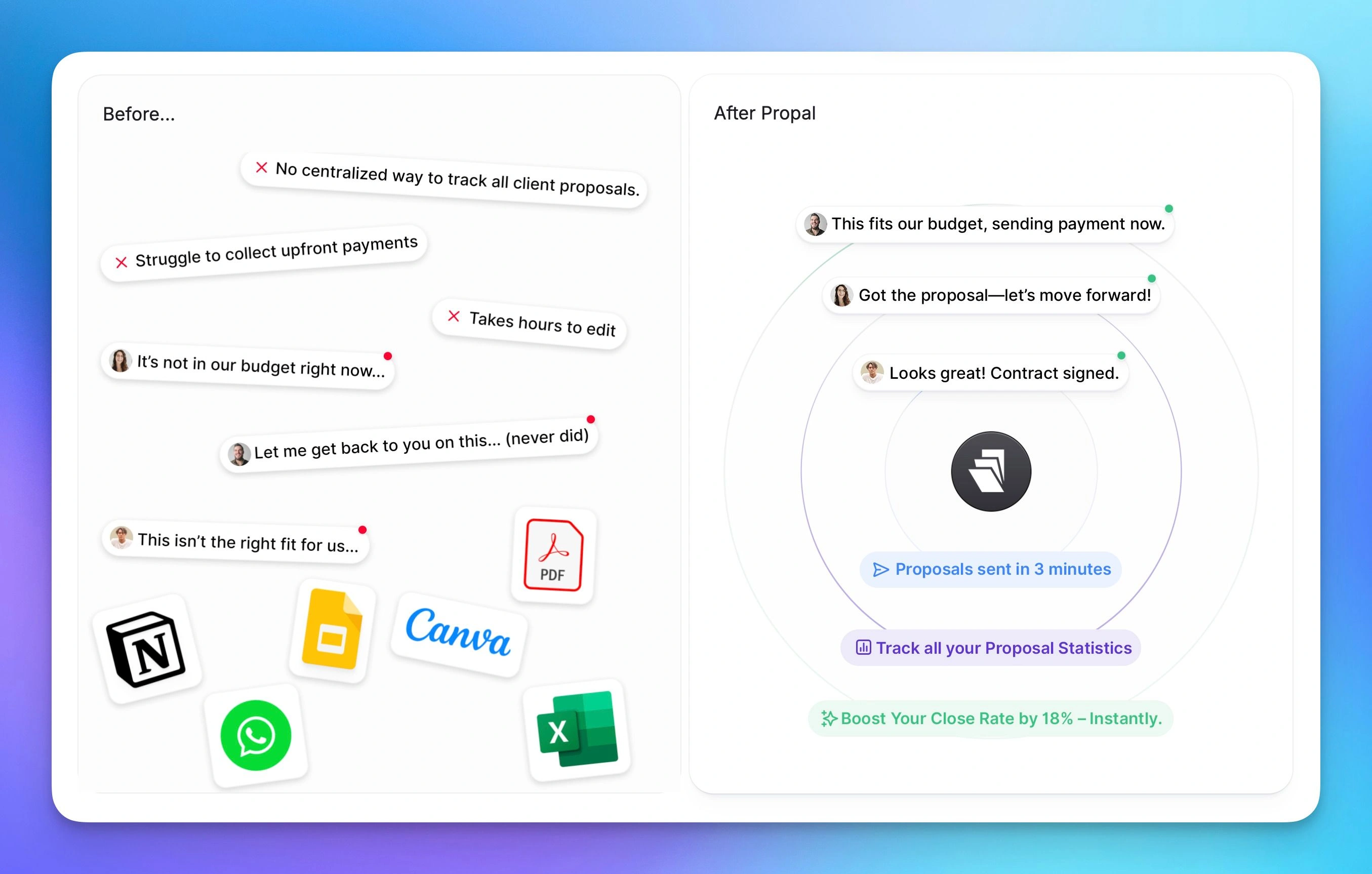
Propal.io creates branded, web-based proposals that you share via link. Real-time tracking shows when clients read your proposal, built-in e-signatures enable instant acceptance, and integrated payments let clients pay without leaving the page. It is designed for agencies and freelancers who want every step from send to signature in one workflow. Start your free trial.
PandaDoc offers document creation with templates, e-signatures, and CRM integration. Best for teams that need proposals alongside contracts and invoicing. See how it compares in our PandaDoc alternatives guide.
Proposify provides a structured proposal workflow with approval chains, content libraries, and analytics. Best for sales teams with governance needs. Compare options in our Proposify alternatives guide.
Conclusion
Knowing how to send a proposal to a client is a skill that directly impacts your revenue. The proposal itself matters, but the delivery, the email, the timing, the format, and the follow-up determine whether it gets read and signed.
The key principles: write a concise, personalized email that highlights value. Send via a tracked link rather than a static attachment. Deliver within 24-48 hours of the discovery call. Follow up with a structured, data-informed cadence. And use a proposal email template approach that you refine over time based on what gets results.
Every proposal you send is a chance to demonstrate professionalism, build trust, and make it easy for your client to say yes. Do not let the delivery be the weak link.
Related resources:
- Proposal Tracking: The Complete Guide
- Interactive Proposals: Why They Close More Deals
- Best PandaDoc Alternatives in 2026
FAQ
What should I write in an email when sending a proposal?
Your send proposal email should include a personalized subject line, a brief reference to your last conversation, 2-3 sentences highlighting the key value of your proposal, a clear link or attachment, and a single call to action. Keep the email under 150 words and focus on why the client should read the proposal, not on describing every section.
Should I send a proposal as a PDF or a link?
A web-based proposal link is the better choice for most B2B service businesses. It opens instantly in the browser, provides real-time tracking data, and enables built-in acceptance and payment. PDFs remain appropriate for formal contexts like public tenders where a specific format is required.
How soon should I follow up after sending a proposal?
Send your first follow-up 2-3 days after the proposal. If you have tracking data, time it based on when the client actually viewed the proposal. The second follow-up should come at day 7 with added value (a case study or relevant insight). Continue with a structured cadence through day 21 before sending a respectful close.
What is the best time to send a proposal email?
Tuesday through Thursday mornings (9-11 AM in the client's time zone) produce the highest open rates. Avoid Monday mornings and Friday afternoons. Most importantly, send within 24-48 hours of the discovery call, regardless of the day. Speed has a stronger impact on acceptance than day-of-week optimization.
How many times should I follow up on a proposal?
Plan for at least 4 follow-ups over 3 weeks. Research shows that 80% of B2B sales require at least 5 touchpoints. Each proposal follow up email should add value rather than just "checking in." After the fourth follow-up, send a respectful close that gives the client an easy exit, which often triggers a response.
.webp)